
For several Australians, the biggest hurdle between them and their dream home is a deposit. It takes months for homeowners to figure out how much they need for a house deposit and even more to save up the amount.
Where do you even begin? Saving a deposit is just only one part of preparing to buy a home. You also need to arrange funds for transfer duty, conveyancing, inspections, lender fees, moving costs & an emergency buffer. Many lenders do offer loans with deposits starting from 5%, while a deposit of 20% can generally help you avoid LMI. The Australian Government 5% Deposit scheme may allow eligible first home buyers, and certain previous homeowners who haven’t owned a home or land in Australia during the preceding 10 years, to purchase with a minimum 5% deposit without paying LMI. Scheme eligibility, property price caps & participating lender requirements apply.
With no deposit home loans, the bridge between your future house and you isn’t a mountain of extra costs, but a helping hand. A family guarantee or equity-based structure may reduce or remove the need for a cash deposit. Government-backed schemes are different because they still require an eligible buyer to contribute a minimum deposit.
Try rentvesting to rent wherever you want and invest in areas you can afford.
While these options may sound like a fast track to home ownership, could it really be as simple as it sounds? No deposit home loans can be a helping hand, but they’re definitely not for everyone. If it sounds too good to be true, perhaps it is. Understanding how the different no deposit & low deposit loan structures work can help you assess which options may be appropriate for your circumstances.
What is a No Deposit Home Loan?
A no deposit home loan is a home loan plan that allows you to borrow the entire purchase or build price of a home without having to pay an upfront cost or a deposit. Also referred to as a zero-deposit loan or 100% home loan, this type of loan replaces the traditional requirement for deposits with alternatives that help support the homeowner. For many home buyers, this can be a considerable advantage, especially if the deposit amount is impossibly high.
Deposits are a safety net for loan lenders; they don’t just protect against a drop in property value, but also ensure the borrower’s financial capacity and discipline. Since zero deposit home loans carry a higher risk for lenders, rigorous financial scrutiny can be expected.
Thorough assessments are conducted to confirm that you have the financial means and ability to repay the loan. The financiers look at your credit history, monthly spending, and overall loan suitability. Your financial records are carefully reviewed, and money management, prior debts and past financial exchanges are closely monitored.
Confused whether to rent or buy in Australia? Check out our guide to learn more.
How do No Deposit Home Loans Work?
No deposit home loans work relatively straightforwardly, at least in theory. In a no deposit structure, the borrower may not contribute a traditional cash deposit. Instead, the lender generally requires additional security, such as a limited family guarantee or equity in another property. However, availability remains subject to lender policy, serviceability, valuation & credit approval.
One common way to structure a no-deposit home loan is through a family guarantor. An eligible family member may provide a limited guarantee supported by equity in their property. This gives the lender additional security. It may also reduce or remove the need for a traditional cash deposit & could help the borrower avoid LMI. The borrower & guarantor must satisfy the lender’s eligibility, credit & financial assessment requirements.
Measure the relationship between the amount you want to borrow and the value of the property you intend to purchase by understanding the importance of the loan to value ratio for home loan approval!
A no deposit loan structure may reduce or remove the need for a traditional cash deposit. But it doesn’t eliminate other purchasing costs. Interest rates, fees & LMI treatment vary depending on the lender, the loan product and the security arrangement. The borrower will remain responsible for repaying the home loan. And where a family guarantee is used, the guarantor may be liable for the guaranteed amount if the borrower defaults.
If the estimated interest rate soars higher than anticipated, in several cases, even a 95% or low deposit loan can prove better for the overall budget. Deposits are a sustainable option if the prior requirements are overwhelming.
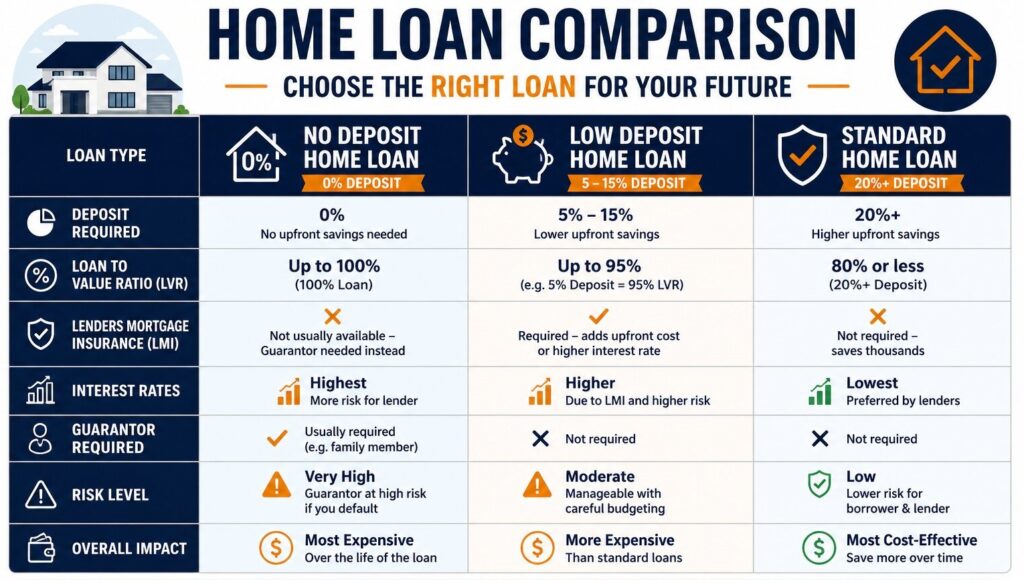
No Deposit Home Loan Vs Low Deposit Home Loan Vs Standard Loans
Zero deposit home loans sound tempting, but what’s the real cost? Compared to all the options present, let’s find out whether it is truly the loan for you!
Related: What is a Low Doc Home Loan?
Cost Examples
When you buy a home, the size of your deposit directly affects the amount you borrow, your interest rate and your monthly repayments. Here’s a simple breakdown of costs under three common depository scenarios.
Let’s assume your property cost is a whopping $500,000.
Get a buyer’s agent to help you find suitable properties in your budget!
For No Deposit Home Loan
- Deposit: zero
- Loan Amount: $520,000 (including additional costs such as Lenders Mortgage Insurance)
- Interest Rate: 7.2% (the interest rate is high given the risk)
- Estimated Monthly Repayment: $3,472
For Low Deposit Home Loan
- Deposit: $25,000
- Loan Amount: $475,000
- Interest Rate: 6.8% (mid)
- Estimated Monthly Repayment: $3,185
For Standard Deposit
- Deposit: $100,000
- Loan Amount: $400,000
- Interest Rate: 6.4% (lower)
- Estimated Monthly Repayment: $2,668
Costs are generally a borrower’s primary concern, but confirming that the loan terms and conditions applied are also favourable is essential. Ensure that you weigh all solutions carefully and choose wisely.
Reduce taxable income by allowing deductions through investment property depreciation.
How to get a Home Loan with No Deposit in Australia
Getting a home loan with zero deposit may seem unlikely, but under the right conditions, it’s possible. Various markers help you qualify for a no-deposit home loan, most of which revolve around financial discipline and credibility. Transparency is key.
Use a Guarantor
The most common way to get a home loan with no deposit is through a guarantor. A family guarantor may provide additional security using equity in their property. Depending on the lender & structure, the guarantee may be limited to a specified portion of the loan. And if the borrower defaults, the guarantor may become liable for the guaranteed amount & could lose an asset used as security. It is a huge financial commitment, which is why the role is generally fulfilled by someone personal to the borrower. Estimate how a family guarantee structure can affect your deposit requirements & potential loan costs. Note that results are indicative only. Use our guarantor loan calculator.
A family guarantor may provide additional security using equity in their property. Depending on the lender & structure, the guarantee may be limited to a specified portion of the loan. If the borrower defaults, the guarantor may become liable for the guaranteed amount & could lose an asset used as security.
A family guarantee may reduce or remove the need for a traditional cash deposit. Also help an eligible borrower avoid Lenders Mortgage Insurance (LMI). Buyers may still need funds for transfer duty, legal fees, inspections & other purchasing costs. Whether a lender will finance any of these costs in addition to the purchase price depends on its lending policy, the available security, the property valuation & the borrower’s financial position.
With a home loan guarantor, your application becomes more attractive to lenders since their risk is reduced. However, both the guarantor and the borrower must understand the legal implications.
Did you know that you could use mortgage offset accounts to save thousands on your home loan interest?
Use Equity as a Deposit
This method can be used by homeowners who already own a property. The equity of your current home can be used as a deposit for your new home. Your property’s current market value minus what you still owe on your mortgage is what we call equity. Lenders may allow you to use a portion of this equity as a deposit for purchasing another property.
Available equity may be used to help fund a larger home, an investment property or other approved purposes, including when you refinance an existing mortgage to access funds. Accessing equity generally increases your secured debt & repayments and remains subject to property valuation, serviceability & lender approval.
Some lenders may periodically offer refinancing incentives. The availability & eligibility can change, and any incentives should be weighed against the interest rate, fees, loan features & total cost of switching. These rebates assist with settlement costs or provide extra funds when necessary. To qualify, your equity must meet minimum lending requirements, and you must demonstrate the ability to service both the existing and the new loan.
Clean Financial Record
Lenders assess your overall financial position when considering a no-deposit home loan. This may include your income, living expenses, existing debts, credit history, account conduct and ability to meet the proposed repayments. Evidence of stable income & responsible financial management may support an application, but approval remains subject to the lender’s credit criteria, serviceability assessment, property valuation & security requirements.
Lenders look for a clean credit report with no defaults, bankruptcies or missed payments. A satisfactory credit history may support an application, but lenders also assess income, expenses, existing liabilities, deposit or security, property acceptability & overall serviceability. Evidence of stable income and employment with minimal to no existing debt, and a sound debt-to-income ratio significantly increases your chance of acceptance. If any of these requirements are not met, lenders might reject your application or require additional forms of security.
Explore expert tips on how to strengthen your real estate investment!
Consult a Mortgage Broker

Expert opinion is always beneficial; a mortgage broker can be your most valuable ally when applying for a no-deposit home. Brokers act as intermediaries between borrowers and lenders and are well-versed in loan structures, eligibility criteria and lender policies.
Through their lender panel, mortgage brokers can identify which policies may accommodate no-deposit or low-deposit applications. A broker can explain relevant government schemes, compare available rates, fees & features, and help prepare your application. Approval, pricing & savings are not guaranteed and depend on the lender and your circumstances. Book an appointment to discuss your potential options.
Pros and Cons of No Deposit Home Loan
Zero deposit loans offer a promising entry into the property market, particularly for those who have struggled to save for a deposit. While the offer is attractive, it is important to recognise its risks. To make an informed decision, understanding the advantages and disadvantages of the financial product is vital. Without proper research, what could have been an opportunity could end up as a financial burden.
Want to save on your home loan? Try offset accounts or redraw facilities to save thousands off your home loan interest!
Pros
Get into the Market Sooner: With no need to save for large deposits, you can purchase your home much sooner. Especially beneficial in competitive markets where waiting to save a deposit may mean having to pay more down the track.
Keep Your Savings: May allow some savings to remain available for purchasing costs & emergencies. The amount required upfront depends on the transaction, lender & applicable government charges.
Access to Grants: Some grants or concessions may be used alongside an eligible loan structure, but each program has separate rules. The lender must also confirm whether the proposed combination is acceptable.
Opportunity to Build Equity: Purchasing sooner allows repayments to begin earlier, but equity growth is not guaranteed. It depends on principal repayments, property-value movements, loan costs & the amount initially borrowed. You can instead use the funds to make extra payments when possible and help improve your home’s value.
Find out how you can pay off your mortgage sooner!
Consider Debt Recycling to build wealth while converting your bad debt to good!
Cons
Interest Increases: With the risk, interest rates are increased, or LMI’s are included if a guarantor is not involved. Over time, this can result in significantly higher repayments compared to traditional home loans.
A higher LVR loan may attract LMI, different pricing or additional lending requirements. Whether LMI applies depends on the lender, effective LVR and any government guarantee or additional security.
Hard Application Process: The application and approval process for no-deposit home loans can be complex and time-consuming. Approval typically requires high income, stability, strong credit history, low existing debt or a guarantor.
Check Out: Can I Use My Super to Buy a House?
Financial Risk: When a no-deposit home is purchased, the buyer’s equity in it is nonexistent. If the property value decreases, you risk owing more money than the home’s worth, resulting in negative equity. Refinancing or reselling the property becomes difficult in the long run, especially without incurring a loss.
Guarantor is at Risk: If you use a guarantor, typically a close family member, they are putting their own property down as collateral. If you default on repayments, your guarantor’s assets are left at risk. This can place immense emotional and financial pressure on both parties.
Have you had a bad financial year? Learn how to refinance for better loan terms with bad credit.
Lending Criteria for a No Deposit Home Loan
No deposit home loans are not available to everyone and can be difficult to qualify for. While one can reduce or eliminate certain requirements through lenders offering specific products or by using a guarantor, the approval process is significantly stricter. Since lenders do not have the financial security of a deposit, they impose certain lending criteria to mitigate risks. These standards confirm the repayment capability of the borrower.
Check your eligibility with a free assessment now!
Good Credit Score
Lenders review your credit report & repayment history as part of the application. A stronger credit profile may support an application, but it doesn’t guarantee approval or particular loan terms. Paying your rent and bills on time, having a low credit card balance and avoiding defaults and late payments are qualities that determine your financial capability. Lenders normally obtain a credit report and may also review your rental payments, account conduct & other evidence of financial management where relevant. A solid credit report not only increases the chance of your approval but could also help you secure better loan terms and lower interest rates.
Here are some tips to improve your credit score.
Lenders review your credit report & repayment history as part of the application. A stronger credit profile may support an application, but it doesn’t guarantee approval or particular loan terms.
Location and Property Restrictions
Not all lenders are flexible with locations and property types. Property acceptance varies between lenders. Location, property type, size, condition, valuation and resale market may affect the maximum LVR and whether the property is acceptable security. Residences in remote or rural areas, or those considered high-risk and difficult to resell, are often excluded due to lower market demand and higher valuation risks. Standard residential dwellings such as houses, townhouses and units are better accommodated than over-the-top, unfinished or highly custom-made properties. Lenders want to ensure that the property retains its value and can be easily sold if needed.
Confused between owner occupied vs investment loans? Find out the perfect choice for you!
Profession
Your profession can influence your eligibility, especially for no deposit loans. Applicants with stable, high-demand careers are viewed more favourably by lenders. Some lenders offer profession-specific policies or LMI waivers to eligible applicants. However, occupation alone does not determine approval. It depends on income, expenses, liabilities, credit history, security and serviceability are still assessed. Based on that, lenders even offer special discounts and exclusive home loan packages for people in these fields. While it’s not necessary to be part of such fields to ensure approval, it does add to the impression.
Why is it essential to get pre-approved for your house loan? Find out exactly why and how!
Employment Status
Not only do lenders verify your current employment status, but they also want to see a track record of stable employment. Job stability ensures your economic consistency and reliability, which is a low-risk factor for lenders. A consistent work history, ideally one to two years with the same employer, while avoiding frequent job changes or employment gaps, confirms that you are a responsible individual with consistent income.
If you’re self-employed, tax return statements and other financial records could be requested for demonstration. Some lenders may accept a shorter employment history if you’re in a professional, low-risk field or have recently made frequent transfers to high-paying positions.
Combine all your debts into one home loan to lower your interest costs and simplify finances.
Income
This is the most obvious one of all: a sufficient and verifiable income is a key guarantor for securing a no-deposit loan. Your income is directly proportional to what you can provide, how efficiently you can make repayments or whether you can afford a home at all.
Lenders will calculate your borrowing capacity based on your gross income, living expenses, and existing financial commitments. The amount available depends on both borrowing capacity and the lender’s acceptable LVR. The lower of these limits will generally determine the maximum available loan. Borrowing the maximum you’re eligible for often comes back to choke you at the throat; assessing your needs and choosing a loan amount that allows for financial flexibility can be helpful in case interest rates hike or emergencies arise.
What If You Don’t Qualify for a No Deposit Home Loan?

Qualifications for a zero deposit home loan can feel a lot like haggling for hundreds at a street market, tiring and close to impossible, but for a good reason. Without a deposit, lenders take on significantly more risks compared to traditional loans. To ensure no defaults occur, strict strategies are put in place. But there’s no need to fret; if you don’t qualify, there are plenty more options. Alternative strategies and government-backed incentives can help reduce the financial burden of a deposit and still get you on the property ladder.
Are you moving to a new property but like your current mortgage enough not to want to change? With home loan portability, you can keep your existing home loan while changing the security itself!
First Home Super Saver Scheme
The First Home Super Save Scheme is a government-led initiative in Australia that helps first-time home buyers save for a home using their superannuation account. A superannuation, or super, account is a special savings account for your retirement in Australia. This program allows eligible buyers to apply to release eligible voluntary super contributions and associated earnings to help purchase their first home. Ordinary compulsory employer contributions cannot simply be withdrawn under the scheme.
On top of your employer’s normal contributions, you can put extra money into your funds. These contributions are taxed at a lower rate, which helps your savings grow faster compared to a regular savings account. Once the amount is fulfilled, you can apply to withdraw the money to buy your first home, where you can get back your voluntary contributions along with your earnings, excluding the tax.
Up to $15,000 of eligible voluntary contributions from any one financial year may count towards the FHSS scheme, subject to a maximum of $50,000 across all years, plus associated earnings calculated under the scheme’s rules.
Help to Buy Scheme
The Australian Help to Buy Scheme is another federal government support initiative that assists eligible buyers in purchasing a home with a deposit of as little as 2%. The government contributes up to 40% of the purchase price for a new home and up to 30% for an existing home, and holds a corresponding equity interest. The amount repayable changes with the property’s value.
Applications for Help to Buy opened on 5 December 2025. The government contributions may reduce the amount borrowed from a participating lender & remove the need for LMI. The scheme may assist eligible lower-income earners and families, but income limits, property price caps, ownership rules & lender requirements apply. However, it’s not a grant. The Australian Government retains a corresponding equity interest that must eventually be repaid.
Australian Government 5% Deposit Scheme (Prev. First Home Guarantee Scheme)
Another government-sourced program in Australia that helps first-time home owners is the First Home Guarantee Scheme. It allows eligible buyers to purchase their home with only 5% deposit, and that without paying the lender’s mortgage insurance (LMI), a fee that can range into thousands for low deposit loans.
The scheme reduces upfront costs and eliminates the need for a guarantor, making it an ideal fit for buyers with stable incomes who haven’t quite saved up a large deposit. There’s also a Family Home Guarantee Scheme based on this very appointment that helps eligible single parents & legal guardians buy homes with only 2% deposit, subject to scheme eligibility & participating lender approval.
Under the Australian Government 5% Deposit Scheme, applicants must be at least 18 years old and an Australian citizen or permanent resident. They must be first-home buyers or have not owned property or land in Australia during the previous 10 years & also have a minimum of a 5% deposit. There are no income caps, but property price caps, owner-occupier requirements & participating lender criteria apply.
Calculate your rental yield to find out how much you can earn from your investment property relative to its value!
Using a Gift Toward Your Deposit
A gifted deposit is money provided by a family member or another donor accepted by the lender, with no expectation of repayment. Lenders may require a signed gift letter or statutory declaration confirming that the funds are a genuine gift, along with evidence showing where the money came from. Whether a gifted deposit is accepted and whether the borrower must also provide genuine savings will depend on the lender’s policy, the LVR ratio and the applicant’s overall financial position.
You might be interested in: Conditional Approval Vs Unconditional Approval.
Tips for First Time Homeowners
As a first-time homeowner, navigating the complexities of home loans, deposits, and lender requirements can be terrifying. While it is a significant milestone to have come so close to achieving your dream, proceeding with caution is essential. The key to managing this process confidently is to understand your financial situation, set realistic goals and approach each step with a clear plan and professional guidance.
Establish a Sound Budget: Even before you browse for homes or entertain the idea of applying for loans, start by setting a clear and comprehensive budget. This includes not just how much you can afford to borrow but how the foregoing costs are to be attended to or fulfilled.
Know Your Purchasing Power: Having a clear understanding of your purchasing power is essential to avoid overcommitting. Just because you qualify for a certain loan amount doesn’t mean you should borrow the maximum. Aim for affordability and flexibility in case your circumstances change.
Consider Added Expenses: Deposit isn’t the only thing you need to worry about; forgetting other costs involved in purchasing a home is a common mistake among first-time buyers. Having a financial buffer for extra expenses like stamp duty, mortgage application fees, LMI if applicable, and miscellaneous legal fees will help avoid stress down the line.
Consult an Expert: Navigating the property market, especially for the first time, can be confusing, full of jargon, hidden fees and legal requirements. Here, expert opinion is essential to help assess your financial situation, understand the property market, compare loan products across multiple lenders, and compare potentially suitable loan options based on your circumstances & the lending products available through the broker’s panel.
Also Check Out: What is a Deposit Bond?
Monetary commitments are serious, and when it comes to home loans, financial decisions become even more complex. Whether you’re buying your first home or moving into a new one, it’s a major milestone both emotionally and economically. Here, a no deposit home loan can seem like a golden opportunity, allowing you to enter the property market without draining your savings. While it is a remarkable proposition indeed, a long-term financial strain is possible if not carefully negotiated.
While putting down a deposit does secure a better financial position, giving lenders more confidence and helping you avoid Lenders Mortgage Insurance (LMI), the property market isn’t waiting. Prices may continue to rise, fall or remain flat as you save, but if they rise, they may potentially push your dream home farther away than it ever was.
Try bridge loans to purchase and secure your new home before selling your old one!
At the same time, taking the zero deposit home loan route isn’t one guaranteed shortcut either. The application and approval process is often more complex, with lenders scrutinising every minor detail of your finances. Ultimately, every option has its pros and cons, and it’s essential to make informed decisions based on your personal economic situation.
If you want access to the best lenders, tailored loan solutions or just expert advice on how to navigate the home loan landscape, it’s smart to speak to a mortgage broker. At Nice Loans, we specialise in helping home buyers like you to find the right solution. Whether you’re cruising for low deposit options, zero deposits or navigating government-sourced schemes, Nice Loans is your trusted mortgage broker based in Brisbane. Compare potentially suitable home loan deals, whatever your circumstances!
FAQ’s
Can you get a home loan with a 5% deposit?
A home loan with a 5% deposit is possible through the Australian Government 5% Deposit Scheme. Eligible applicants may purchase with a minimum 5% deposit without paying LMI. Outside the scheme, many lenders also offer loans with deposits below 20%, although LMI or other requirements may apply.
Is it better to save a deposit or a no deposit home loan?
If you have the resources to fund your deposits backed by governmental and local lending schemes, deposits can help avoid LMI and also give you access to lower interest rates. While no deposit home loans are an expert solution to get into the property market sooner without tapping your savings. Both options have their advantages and drawbacks; the right solution depends on your financial situation, risk tolerance and urgency to enter the market.
How high will the interest rate for a no-deposit home loan be?
The interest rates for no-deposit home loans are usually higher than standard loans. However, the increase in interest isn’t always extreme. Thanks to competition among lenders, competitive rates are readily available if your credit scores and financial profile are stable.