

After weeks, sometimes even months, of property inspections, negotiations, paperwork, finance approvals, and stress, settlement day is finally here!
For many Australians, this is the moment everything becomes real. The property officially changes hands, the funds are transferred, and the buyer becomes the legal owner.
As mortgage brokers, we’ve guided hundreds of clients through settlement day. Some settlements are smooth and seamless, while others get delayed due to missing paperwork or stressful timing issues. Understanding exactly what happens before, during and after settlement can help you avoid surprises and feel more confident throughout the process.
Whether you’re buying your first home, upgrading, downsizing, or refinancing, here’s everything you need to know about property settlement in Australia.
Rent where you want to, while investing where you can afford by rentvesting!
What is Property Settlement?
Property settlement is the legal and financial process where ownership of a property transfers from the seller to the buyer. On settlement day, the buyer pays the remaining balance of the purchase price while the seller receives the funds. With the legal documents exchanged, the buyer officially becomes the new owner of the home.
The settlement period begins once both parties sign the contract of sale, and this usually lasts between 30 and 90 days. The timeframe allows enough time for finance approval, property searches, legal checks, property valuations, insurance and mortgage documentation.
Buying a second home? Learn how you can fund your home loan!
How Long Does Property Settlement Take?
This is the one question clients often ask. In Australia, property settlement typically takes between 4 and 12 weeks from contract signing, depending on what’s negotiated in the contract.
Did you know that you could purchase a property through a trust?
How Long Does Settlement take on Settlement Day?
The settlement appointment itself usually takes between 30 minutes and 2 hours. However, the entire day can feel longer because banks process funds at different speeds, and since multiple parties are involved, final adjustments need multiple confirmations.
So, if you’re wondering how long settlement takes on the actual day, I would say most buyers receive confirmation sometime between late morning and mid-afternoon. One thing I’d advise as a mortgage broker is not to book removalists too early in the morning. Even when everything appears ready beforehand, delays can happen; therefore, it’s wise to take it easy.
With home loans for low income earners, budget well and buy affordable properties!
Who is Involved in the Property Settlement Process?
Several parties work together behind the scenes to complete the settlement successfully. These usually include:
- The buyer
- The seller
- The buyer’s conveyancer or solicitor
- The seller’s conveyancer or solicitor
- The buyer’s lender
- The seller’s lender
- The mortgage broker (if applicable)
- The real estate agent
In many transactions, your mortgage broker plays a key coordination role between the bank, conveyancer and client to ensure deadlines are met. At our brokerage, we regularly follow up with lenders before settlement to avoid common issues like missing documents, incorrect payout figures, delayed valuations and more. We believe these small details can make a huge difference.
Cut down on tax with a salary sacrifice home loan!

What Happens Before Settlement Day?
Several important steps need to be followed before settlement can successfully happen. These typically include:
- Financial Approval: Your lender completes the assessment and formally approves the loan. This is also called unconditional approval, and this usually takes place after pre-approval or conditional approval. Without this, the settlement cannot proceed.
- Property Valuation: The lender confirms that the property value readily supports the loan amount. If the valuation comes in lower than expected, buyers may need to contribute extra funds to balance the loan-to-value ratio.
- Signing Loan Documents: You’ll receive formal loan contracts outlining interest rates, repayment terms, home loan features and all fees and charges. These documents must be signed and returned before settlement.
- Building Insurance: Most lenders require building insurance before releasing funds. This is especially important for houses and freestanding properties.
- Final Inspection or Pre-settlement Inspection: The pre-settlement inspection is your opportunity to confirm the property is still in acceptable condition. This usually occurs within the week before settlement. Here, you are expected to check whether the appliances work properly, fixtures remain in place, rubbish has been removed, etc.
Transfer your existing home loan to a new property with home loan portability!
What Happens on Settlement Day?
Settlement day is mostly handled by your conveyancer, solicitor, lender and mortgage broker behind the scenes. You usually do not need to attend in person, but in case you’re curious about the mechanism, here’s what happens.
When applying for a mortgage, understanding offset and redraw can potentially save you thousands in interest. Try now!
What Happens on Settlement Day for the Seller or Vendor?
If you are a seller or vendor, the settlement day process begins with your bank transferring the loan funds to the seller’s representative. The funds include your remaining purchase amount, stamp duty, council rate adjustments, water adjustments, and strata adjustments if applicable.
Next, your legal documents are exchanged. The buyer’s and seller’s representatives exchange legal documents electronically or in physical form. These documents confirm ownership transfer.
A deposit bond can help you secure a property without an upfront deposit!
With your transfer documents in your conveyancer’s hands, they lodge the documents with the land titles office. Once it’s processed, you become the official owner. With the settlement confirmed, the real estate agent releases the keys. This is the exciting moment. Many of my clients tell me that this is the point where all their stress finally disappears.
Maintain a high credit score by avoiding many loan applications and keeping your debt low!
What Happens on Settlement Day for the Buyer?
For sellers, settlement day marks the completion of the sale process. It officially begins with the existing mortgage being paid out. If there is still a mortgage on the property, the seller sends the payout amount to their lender, finally closing the account.
Read: Negative Gearing vs Positive Gearing: Pros and Cons.
After the mortgage and adjustments are paid, the remaining proceeds are transferred to the seller. Along with that, the signed transfer documents are handed over to the buyer’s representative.
With the official paper handover done, every spare and home keys are handed to the agent for collection. This includes garage remotes, mailbox keys, and alarm codes, too.
Lower your mortgage interest by linking savings to your home loan with offset accounts.
What Happens after Settlement Day?
Once settlement is completed, your conveyancer or solicitor will confirm that ownership of the property has officially transferred into your name. The moment you have been waiting for is finally here.
In most cases, the real estate agent will contact you shortly after settlement confirmation to arrange key collection. Depending on timing, many buyers can move in on the day of settlement itself.
The most common question I get from clients after settlement is: When does my first repayment start? Your first home loan repayment period date depends on your lender, loan structure, and home loan repayment frequency.
Let’s assume that you have selected fortnightly repayments. Your first repayment is generally due around two weeks after settlement. Some lenders may also allow you to choose your preferred repayment date within certain limits.
Are you self-employed, looking for a home loan? Self-employed home loans can help you achieve your homeownership goals!
Post Settlement Checklist
After settlement day, there are several important things to arrange to ensure a smooth transition into your new property.
- Collect the keys.
- Connect utilities all around the home.
- Set up loan repayments.
- Update your address for all service providers and important organisations.
- Review your building insurance activation.
Did you know that you could fund your self-managed build with an owner builder home loan?
How Do You Choose the Right Settlement Period?
Choosing the right settlement period is an important part of the contract negotiation process and can have a major impact on how smoothly the transaction unfolds.
In most cases, the proposed settlement date is included in the contract of sale and negotiated between the buyer and seller before the contract becomes unconditional. While sellers often nominate a preferred timeframe, both parties ultimately need to agree on a date that works for everyone involved.
Buy your dream home at 2% deposit and no LMI with the family home guarantee scheme!
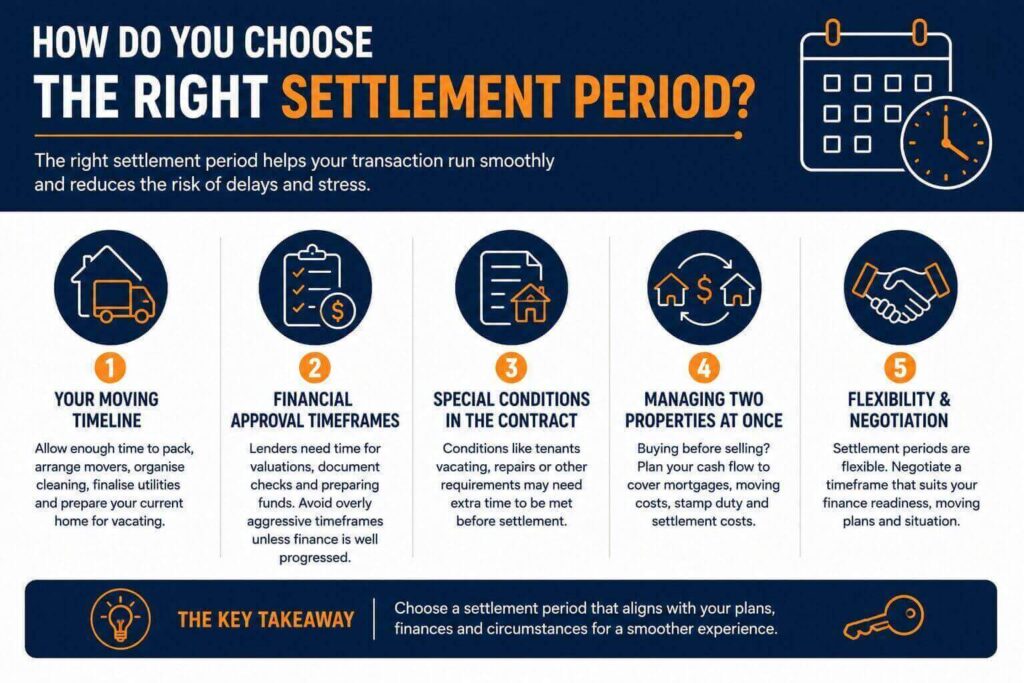
Here are all the things to consider when choosing a settlement date:
Your Moving Timeline
If you’re relocating to another property, consider how much time you realistically need to pack your belongings, arrange removalists, organise cleaning, finalise utilities and prepare your current home for vacating. You need to allow enough buffer time to significantly reduce the moving stress.
Find out how much house you can afford using income, debts and down payment calculations!
Financial Approval Timeframes
One of the biggest reasons settlements are delayed is the uncertainty in financial approval timelines. Even if you already have home loan pre-approval, your lender still needs time to complete valuation checks, finalise loan documents, verify financial information and prepare settlement funds. We often recommend buyers to avoid overly aggressive settlement timeframes unless their financing is already well progressed.
Special Conditions in the Contract
Some contracts include conditions that require additional time before settlement can occur. Examples include: tenants vacating the property, repairs being completed, pest or building issues being resolved and other conditions that are subject to sale. If these conditions aren’t properly accounted for, settlement delays can happen quickly.
Consider debt recycling to convert your home loan debt into a tax-deductible expense.
Managing Two Properties at Once
If you’re buying before selling your current home, you’ll need to carefully consider your financial position. For a short period, you may need to cover your existing mortgage, your new home loan, moving costs and your stamp duty and settlement costs. Planning your cash flow during this transition is extremely important.
Ultimately, you should be aware that settlement periods are flexible and can often be negotiated to suit both parties. In instances where a seller wants a longer settlement to organise their move, a buyer wants to request a shorter settlement to move in sooner, and investors may negotiate around existing lease agreements, the key is to make sure the settlement timeframe aligns with your finance readiness, moving plans and overall situation.
Use your super for your first home deposit!
What Costs are Paid at Settlement?
Several costs are calculated and finalised on the settlement day, including:
- Stamp duty
- Conveyancing Fees
- Lender Fees
- Council rates and adjustments
- Water rate adjustments
- Strata levies
Your conveyancer prepares a settlement statement outlining all these figures; you ought to review these carefully before approving the settlement.
Try no deposit home loans to buy a home without any upfront savings!
What is a Settlement Statement?
A settlement statement is a document that shows exactly what must be paid at settlement. This includes your purchase price, the deposit paid, government charges, legal funds, loan funds and all miscellaneous adjustments. Both the buyer and seller should review the statement carefully to prevent inaccuracies.
Rent now with the option to buy later with the rent to buy scheme.
Can I Change the Settlement Date After the Contract Has Been Signed?
Absolutely, it is possible to change the settlement date after your contract has been signed, but here’s the catch: both the buyer and seller must agree to the change.
Once a contract of sale becomes legally binding, the original settlement date remains enforceable unless both parties formally approve a change. Any variation to the agreed settlement date is usually documented in writing and signed by both parties through their conveyancers or solicitors.
Try a reverse mortgage and home equity release to access your home equity without selling!
You might be surprised, but settlement date changes are more common than you realise. As mortgage brokers, we regularly see settlement extensions requested for reasons such as delays in formal finance approval, bank processing issues, valuation delays and more. Sometimes buyers simply underestimate how long the settlement takes, particularly when relying on lender turnaround times.
Your debt to income ratio shows how much debt you have compared to your income!
What is Simultaneous Settlement?
Simultaneous settlement is when the sale of your current property and the purchase of your new property both settle on the same day.
Buying your first home in Victoria? Explore all government grants and schemes available in VIC!
Simply put, the money from your sale is immediately used to fund the purchase of your next home. This type of arrangement is common for homeowners upgrading to a larger property, or downsizers purchasing a smaller home, families relocating to a new area, and property
For various Australians, simultaneous settlement can make moving financially easier because it reduces the need to access large amounts of cash upfront while waiting for their existing property to sell.
Use a guarantor on your home loan to avoid LMI and boost your borrowing power for low deposit loans!
Can a Buyer Move in on Settlement Day?
Yes, in most cases, buyers can move into the property on settlement day once the settlement process has been completed and ownership has officially transferred. However, while moving in on settlement day is possible, it’s not always the most practical option.
As mortgage brokers, we’ve seen settlement days run smoothly, but we’ve also seen unexpected delays at the last minute. This is why many recommend allowing a small buffer between settlement and your actual move-in date, where possible.
Try the help to buy scheme to make homeownership achievable as a low-income Australian!

Ready for Settlement Day?
Settlement day is one of the most important milestones in the property journey. After weeks or months of inspections, paperwork, financial approvals and planning, it’s the moment everything finally comes together.
But as exciting as it is, settlement can also feel overwhelming, especially if you’re navigating the process for the first time. At Nice Loans, your home loan specialist based in Brisbane, we help Australians understand every stage of the home loan and settlement process, from pre-approval right through to getting your home keys.
We’ve guided clients through everything from straightforward first-home purchases to complex simultaneous settlements and refinance transactions. Having the right support can make a huge difference when it comes to avoiding delays, understanding your finance and ensuring settlement runs as smoothly as possible.
If you’re planning to buy property and want expert guidance around finance, approvals, and settlement, contact Nice Loans today and book an appointment with our team.
FAQs
How long does settlement take in Australia?
The settlement of a home loan in Australia takes from 30 to 90 days from the date the contract of sale is signed.
What if the settlement is delayed unexpectedly?
Settlement delays are common; therefore, we advise buyers to avoid booking removalists too tightly around settlement timing. Having experienced professionals managing your finance and legal process can significantly reduce the risk of delays and help resolve issues quickly if they arise.
Calculate your rental yield to find out your rental income vs property value!
What are the risks of a long settlement period?
One of the biggest risks with an extended or long settlement period is simply that there’s more time for unexpected issues to occur. These periods become problematic due to changes in the buyer’s financial situation, delays in finance approval, property valuation issues, interest rate changes and market fluctuations.
The longer the settlement timeframe, the greater the chance that something may affect either party’s ability or willingness to proceed.
What types of settlements are there?
There are many types of property settlements in Australia, and the process can vary depending on whether you’re buying, selling, refinancing or doing both at the same time. The three main ones are standard settlement, simultaneous settlement, and refinance settlement.
Standard settlement is when a buyer purchases a property from a seller, and settlement takes place on the agreed date in the contract of sale. Simultaneous settlement, on the other hand, happens when you sell one property and purchase another on the same day. While a refinance settlement occurs when an existing home loan is replaced with a new loan, either with a different lender or under a new loan arrangement.
Try bridge loans to buy a new home before selling your current one!
How do you request settlement date changes?
Settlement changes are handled by either your solicitor, your conveyancer or mortgage broker working alongside your lender. Your legal representative will usually contact the other party’s conveyancer to negotiate the revised timeframe and prepare the necessary contract variation documents.
While there could be financial implications, particularly if the delay causes additional costs for the other party, it is entirely situational.