
Whether you’re purchasing your first home or planning to grow your property portfolio, choosing between an owner occupied vs investment loan is one of the most important decisions you might need to make. The type of loan you choose doesn’t just determine your interest rate but can influence your borrowing power, loan features, tax obligations, repayment options and long-term financial strategy.
After helping Australians secure finance for everything from their first home loan to multiple investment properties, one of the most common questions I get is, ‘Which loan type is right for me?’ And the answer is simple: depending on your property goals and how you plan to use the property, you can make your choice without suspicion.
As we move along, we’ll be breaking down the differences between owner occupied and investment loans. Although both are forms of property loans, lenders assess them differently because each carries a different level of risk. Understanding these risks can help in choosing whether you should buy a property to live in, a property to rent out, or hold for capital growth.
Recently divorced and wondering what to do with your mortgage? Take a look at our guide to mortgage and property settlement after separation to learn everything you need to know.
What is an Owner Occupied Home Loan?
An owner occupied home loan is designed for people who intend to buy a property and live in it as their primary residence. This type of home loan intends to support a build that will be your home to live in, rather than a rental property or an investment.
When comparing an owner occupied vs investent loan, one of the biggest differences is how lenders assess risk. Borrowers are generally more likely to prioritise repayments on the home they live in, making owner occupied loans lower risk from a lender’s perspective. As a result, owner occupied home loan rates are often lower than investment home loan rates, potentially saving thousands of dollars over the life of the loan.
Depending on your circumstances and the lender’s policy, an owner occupier home loan also offers benefits such as:
- Lower interest rates and competitive comparison rates
- Smaller home loan deposit requirements for eligible borrowers
- Access to government assistance available to first-home buyer applicants
- Flexible loan features, including offset accounts, redraw facilities and the choice between fixed rate and variable rate home loan options
One of the most common misunderstandings I have seen clients have is believing that they can apply for an owner occupied loan simply because they may move into the property at some point in the future. In reality, lenders assess your intended property use at the time of settlement, so it’s important to be transparent during the application process. To avoid approval delays and cancellations, a clear motive for home loan selection is vital.
How to Apply for an Owner Occupied Home Loan?
If you’re ready for a home loan, preparing the right documentation before you submit your application can make the approval process smoother and help avoid unnecessary delays.
When applying for a loan, your lender will assess your overall financial position to determine whether you can comfortably manage the proposed loan repayments. They’ll consider factors such as your income, employment stability, existing debts, living expenses, savings history and credit score, along with the loan amount you’re requesting.
Buying your first home in Victoria? Explore all government grants and schemes available in VIC!
Typically, you’ll be asked to provide the following documents:
- Recent payslips or proof of income
- Bank statements and evidence of savings
- Tax returns and financial statements if you’re self-employed
- Details of your current assets and liabilities
- Identification documents
- Information about the value of the property you’re purchasing, including the signed contract of sale if available.
Once your loan application has been submitted, the lender will review your financial information and may request additional documentation before making a decision. Depending on your circumstances, they may also arrange an independent valuation of the property to confirm its market value.
Did you know that a buyer’s agent can help you not only find suitable properties but also negotiate favorable terms?

Types of Owner Occupied Home Loans
Not all owner occupied home loans are the same. Among the options available, selecting a loan that offers the flexibility and features you need is essential.
Fixed Rate Home Loan
A fixed rate home loan locks your interest rate for an agreed period of time, typically between one and five years. Your repayments remain the same during the fixed term, making it easier to budget and protect yourself from rising interest rates.
Fixed rate loans are perfect for borrowers who value certainty and want predictable loan repayments, particularly first home buyers managing a new mortgage.
Variable Rate Home Loan
A variable rate home loan has an interest rate that can increase or decrease over time in response to changes in market conditions and the lender’s pricing. While repayments can fluctuate, variable loans often provide greater flexibility than fixed rate loans. Many include useful loan features like offset accounts and redraw facilities, along with the ability to make additional repayments without significant restrictions.
Construction Home Loan
A construction loan is designed for borrowers building a new owner occupied home rather than purchasing an established property. Unlike a standard home loan, the funds are usually released in stages as construction progresses. This means you generally only pay interest on the amount that has been drawn down during the building process, helping manage costs while your home is under construction.
Home Loan Refinance
Refinancing allows you to replace your existing home loan with a new one, either through your current lender or a different provider. Many homeowners refinance to secure a lower interest rate, access better loan features, consolidate debts, reduce monthly repayments or switch between fixed-rate and variable interest options as their financial needs change.
As a mortgage broker, we’ve found that many borrowers continue paying higher home loan rates simply because they haven’t reviewed their mortgage in several years. Even if your circumstances haven’t changed, refinancing could provide savings or more suitable loan terms.
Bridging Home Loan
A bridging loan is a short-term finance solution for homeowners who want to purchase a property before selling their existing home.
Instead of waiting for your current property to sell, a bridging loan provides temporary funding to help you buy your next owner occupied home. Once your existing property is sold, the sale proceeds are typically used to reduce or repay the bridging loan.
Rent where you love and invest where you can afford by rentvesting!
What is an Investment Loan?
An investment loan is a loan used to purchase a property that is intended to generate income rather than serve as your primary residence. Whether you’re purchasing an investment property for rental income, a long term capital growth, or both, this loan type is specifically designed for borrowers looking to grow their wealth through real estate.
When comparing an owner occupied vs investment loan, the key difference lies in the purpose of the property. An owner occupied home loan is for a property to live in, while an investment home loan is for a property that will be rented to tenants or held as a long-term investment.
Read: Guide to Buying a Second Home.
Since investment lending carries more uncertainty, lenders generally consider these loans to be higher risk. Rental income can fluctuate, tenants may vacate the property unexpectedly and property values can rise or fall with market conditions. Because of this, investment loans are offered with higher interest rates compared to owner occupied loans, and lenders may apply stricter lending criteria during the approval process.
Here are some investment loan benefits that appeal to property investors:
- The ability to claim eligible tax deductions such as loan interest, property management fees, maintenance and depreciation costs, subject to Australian tax laws and advice.
- The option to use equity in an existing property instead of relying solely on cash savings for a deposit.
- Access to repayment structures such as interest-only loans, which can assist with short-term cash flow, depending on the lender and your financial circumstances.
How to Apply for an Investment Home Loan?
The process of applying for an investment loan is not very different from applying for any other home loan, but lenders generally apply stricter assessment criteria. Since an investment property loan relies partly on rental income and market conditions, lenders take a closer look at your financial position to ensure you can comfortably manage the debt.
Did you know that Australian expat home loans allow you to buy property in Australia while living overseas?
When you apply, lenders will assess:
- Your income and employment stability
- Existing debts and financial commitments
- Living expenses and overall serviceability
- Your credit history
- The requested loan amount
- Your loan-to-value ratio (LVR)
- The expected rental income from the property
If you’re already a property investor, the lender will also review your existing property loans, current loan balances and ongoing loan repayments to determine whether you can comfortably support another mortgage.
To back your application further, you may be asked to provide documents like recent payslips or proof of income, bank statements and evidence of savings, tax returns if you’re self-employed, details of your assets and liabilities, identification documents and existing mortgage statements if any. Apart from these, a signed contract of sale or information about the value of the property being purchased is also essential.
Purchase your home at just 5% Deposit with the Australian Government 5% Deposit Scheme.
From personal experience, one tip I’d like you to remember is to strive to demonstrate strong financial management in any way you can. Reduce your personal debts, maintain genuine savings, avoid unnecessary credit applications and keep a stable income to improve your chances of home loan approval and secure more competitive investment rates.

Types of Investment Home Loans
Not every investment home loan is structured the same way. Depending on how you plan to purchase and hold your investment properties, a specialised loan that suits your ownership structure and financial objectives may be necessary.
Try Trust Home Loans to improve asset protection and tax flexibility.
SMSF Investment Home Loan
Using your super to buy property is an excellent idea. An SMSF (Self Managed Super Fund) investment home loan is designed for trustees who want to purchase an investment property through their superannuation fund.
These loans are subject to strict Australian superannuation and lending regulations, and are typically structured as Limited Recourse Borrowing Arrangements (LRBAs). They can be an effective strategy for long-term retirement planning, but they also involve complex legal and compliance requirements. Before proceeding, it’s important to seek advice from a qualified financial adviser, accountant and mortgage broker experienced in SMSF lending.
Find out how to get a home loan if you’re self employed.
Trust Investment Home Loan
A trust investment home loan is designed for borrowers who purchase an investment property through a family trust, discretionary trust or unit trust.
Many property investors choose a trust structure for asset protection, succession planning or taxation purposes. However, lending to trusts can involve additional documentation, personal guarantees from directors or trustees, and different serviceability requirements compared with borrowing in an individual’s name.
Expat Investment Home Loan
An expat investment home loan is designed for Australian citizens and permanent residents living overseas who want to invest in Australian property. While expat borrowers often get a home loan, lenders usually apply different criteria depending on the country of residence, currency of income and employment arrangement. In several cases, borrowers may need a larger home loan deposit or meet additional documentation requirements before their loan application is approved.
Differences Between Owner Occupied Vs Investment Loans
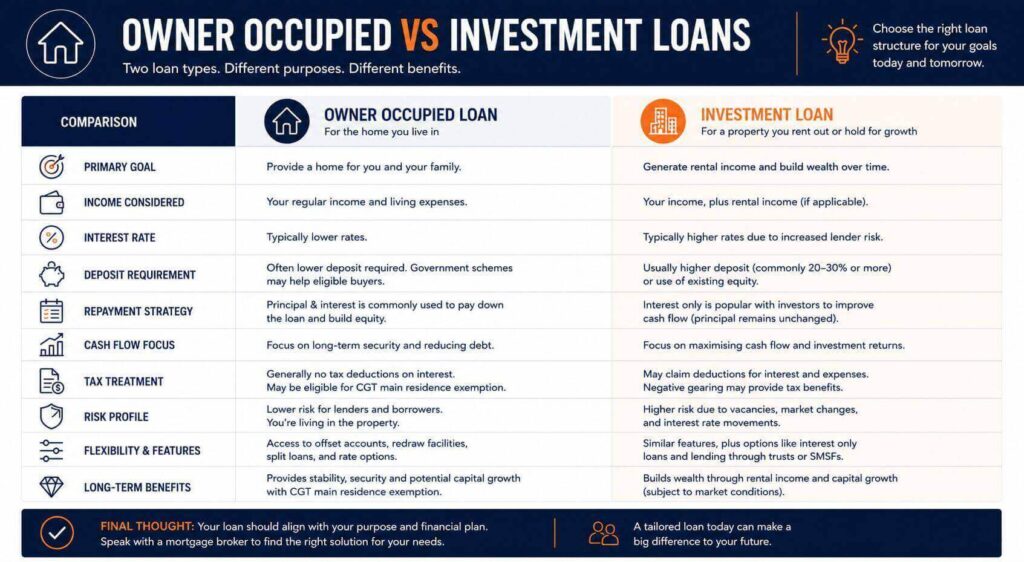
When comparing an owner occupied vs investment loan, the differences go well beyond who lives in the property. Your chosen loan type affects everything from home loan features to repayments, and even government assistance programs you may qualify for.
How the Property Will Be Used
The biggest distinction between owner occupied and investment loans is the intended property use. An owner occupied home loan is designed for borrowers purchasing a property to live in as their primary residence. The home becomes your principal place of residence, meaning you genuinely intend to live there after settlement.
On the other hand, an investment loan is intended for a property that will be rented to tenants or held to generate capital growth. The property is purchased to produce rental income rather than serve as your main home.
Reduce your taxable income for tax benefits with salary sacrifice.
Loan Costs
In many cases, owner occupied home loan rates are lower because lenders consider borrowers less likely to default on the home they live in. When a comparison is made, investment loans are typically offered with higher interest rates because lenders assume greater risk. Rental vacancies, fluctuating property values and changes in rental income can all affect an investor’s ability to meet repayments.
Even though the difference in rates is small, it can add thousands in additional interest over the life of the loan, making it worthwhile to compare lenders carefully.
Loan-to-Value Ratio (LVR)
Your loan to value ratio (LVR) compares your loan amount with the value of the property you’re purchasing. Many lenders allow higher LVRs for owner-occupied home loans, particularly for eligible borrowers who qualify for government initiatives or are willing to pay Lenders Mortgage Insurance (LMI).
For an investment property loan, lenders often adopt a more coservative approach. Although lending policies vary, investors may be required to contribute a larger deposit or use equity from another property to reduce the LVR.
Tax Considerations
Tax treatment is another major difference between owner occupied and investment lending. An owner occupied home generally doesn’t provide income tax deductions on mortgage interest because the property isn’t producing passive income. However, eligible homeowners may benefit from the Capital Gains Tax (CGT) main residence exemption when selling their home.
With an investment property loan, investors may be able to claim eligible expenses such as loan interest, property management fees, maintenance costs and depreciation. Depending on individual circumstances, negative gearing may also provide taxation benefits.
How Applications are Assessed
Whether you’re applying for a home loan or applying for an investment loan, lenders assess your financial position before approving finance.
For an owner occupied loan, lenders will generally confirm that the property will be your principal place of residence while assessing your income, employment, credit history, deposit and living expenses.
For an investment home loan, lenders usually apply stricter serviceability requirements. They’ll assess your existing debts, projected rental income, ongoing expenses and overall borrowing capacity to ensure you can comfortably manage your financial commitments.
Repayment Structures
Both owner-occupied and investment loans generally offer flexible repayment options. Borrowers purchasing a home to live in commonly choose principal and interest repayments, gradually reducing the loan balance while building equity.
For investment lending, many property investors consider interest only loans to improve short-term cash flow. While this can reduce repayments during the interest only period, the principal remains unchanged, meaning higher repayments may apply once the interest-only term ends.
Pay off your mortgage faster by making extra repayments and switching to fortnightly payments.
Government Support
Government assistance is an important distinction in the owner occupied vs investment loan comparison. Eligible first home buyer applicants purchasing an owner occupied home may qualify for government initiatives such as the First Home Guarantee or state-based stamp duty concessions, depending on where they purchase.
These incentives generally aren’t available for investment properties, meaning investors usually rely on genuine savings or equity to fund their purchase.
Related: Australian Government Help to Buy Scheme.
The Risks
From a lender’s perspective, owner occupied loans are generally considered lower risk because borrowers tend to prioritise repayments on the home they live in. An investment loan carries additional risks like vacancy uncertainties, rising interest rates or changes in the property market that can all affect cash flow and investment returns.
One recommendation we often make to clients purchasing a rental property is to maintain a financial buffer that can cover repayments and expenses during period of vacancy or unforeseen maintenance.
Additional Loan Benefits
Many owner occupied home loans include flexible loan features such as offset accounts, redraw facilities and the option to choose between fixed rate and variable rate repayments. An investment home loan may also include these features, along with options like interest only loans, making them attractive for investors focused on cash flow. Borrowers purchasing through an SMSF or trust may also require specialised lending solutions designed for those ownership structures.
You Might be Interested in: How to Get Approved for an Owner Builder Loan?
What are the Similarities Between Owner Occupied Vs Investment Loans?
While there are important differences in the owner occupied vs investment loan comparison, both owner-occupied and investment loans follow many of the same lending principles. Whether you’re buying a home to live in or expanding your property portfolio, lenders assess your financial position to ensure you can comfortably manage the loan.
Financial Assesment
Whether you’re applying for a home loan or an investment loan, lenders will evaluate your overall financial position before approving your application. This typically includes reviewing your income, employment history, living expenses, existing debts, credit history and savings to determine your borrowing capacity.
As mortage brokers, we’ve found that borrowers with stable income, a strong repayment history and sensible financial habits are generally in a better position to get a home loan with competitive terms, regardless of the loan type they choose.
Transfer existing home loan to a new property with home loan portability.
Repayment Options
Both owner occupied home loans and investment home loans usually offer flexible repayment options. Depending on the lender and your circumstances, you may be able to choose between principal and interest repayments or interest only loans.
The most suitable option depends on your financial goals, cash flow and long-term repayment strategy rather than simply selecting the option with the lowest monthly repayment.
Try no deposit home loans to borrow the full home price while skipping the upfront deposit!
Credit and Serviceability Requirements
Regardless of whether you’re purchasing a home to live in or an investment property, lenders assess your serviceability before approving finance. This means they want to see that you can comfortably meet your loan repayments, even if interest rates increase or your financial circumstances change.
Property Valuation
Both owner-occupied and investment property loans require the lender to assess the value of the property being used as security. In most cases, an independent valuation is complete to confirm the property’s market value before the loan is formally approved.
Secure your dream property without an upfront deposit with deposit bonds!
Flexible Loan Features
Many lenders offer similar loan features across both loan types, including offset accounts, redraw facilities, online banking and the choice between fixed rate and variable rate options. The availability of these features will vary between lenders and individual loan products.
Government Assistance
Governent support differs depending on the loan purpose. Eligible first home buyer programs, such as the First Home Guarantee, Family Home Guarantee, and certain state-based concessions, are generally available only to borrowers purchasing an owner occupied home.
By contrast, investment loans don’t usually qualify for these schemes. However, investors may benefit from taxation provisions associated with investment properties, such as claiming eligible expenses and depreciation, subject to current tax legislation and professional advice.

Choosing the Right Home Loan for Your Goals
Ultimately, deciding between an owner occupied vs investment loan isn’t just about securing the lowest interest rate, it’s about choosing a loan that aligns with your financial objectives, lifestyle and long-term property goals.
One of the most important things to remmeber when applying for a home loan is to be honest about how you plan to use the property. If you’re purchasing a property to live in, an owner occupied home loan may be the right choice. If you’re purchasing an investment property that will generate rental income, you’ll generally need an investment home loan.
From my experience as a mortgage broker, many borrowers assume that they should always apply for an owner occupied loan because the owner occupied home loan rates are often lower. However, lenders assess the purpose of the property during the application process and providing inaccurate information about your intended property use can breach your loan terms and may require your loan to be reclassified if your circumstances change.
In the end, regardless of the loan type you choose, there are ways to improve your chances of securing competitive terms. First, work on reducing your existing debts before submitting your application. Maintain a strong credit history by making all your repayments in time and save a larger home loan deposit where possible.
I often encourage clients to look beyond the headline rate. Features such as offset accounts, redraw facilities and more can make a significant difference over the life of the loan. An experienced mortgage broker can compare lenders, explain your options and help you find a finance solution that suits your circumstances, both now and in the years ahead.
Try low doc home loan options for non-traditional income earners to buy property.
Ready to Apply?
Whether you’re preparing to buy your first home, upgrading to a new property, or building wealth through investment properties, choosing the right finance solution can make a significant difference to your long-term results.
At Nice Loans, our experienced mortgage brokers help Australian borrowers understand their options, compare suitable loan products, and navigate the lending process with confidence. Whether you need an owner occupied home loan, an investment home loan, or guidance on choosing between an owner occupied vs investment loan, we can help you find a solution aligned with your financial goals.
Get in touch with Nice Loans, one of the best home loan specialists in Australia to discuss your options and take the next step towards securing the perfect home loan for your future.
FAQs
Can you switch an owner occupied home loan to an investment loan?
Yes, you can switch an owner occupied loan to an investment loan but its absolutely essential you notify your lender befor doing so. This change can have a huge impact on your loan terms, including adjustments to your interest rate, repayment structire and possibly other conditions, therefore, if you do not inform your lender, they could breach the terms of your loan agreement.
Can you switch an investment loan to an owner occupied loan?
Sure, if you move into the property and it becomes your primary residence, you may be able to convert your investment home loan to an owner occupied home loan. If your lenders assessment of your property being your principal place of residence is approved, you may be eligible for owner occupied home loan rates, depending on the lender’s policy.
How soon can I rent out my home after buying an owner occupier?
While there is no universal waiting period that applies to every lender, some lenders may expect borrowers to occupy the property for a minimum period, others assess each situation individually. The period is often around 6 months after one has moved in.
Is it better to buy an owner-occupier or an investment property?
Whether an owner occupier is better than an investment property or the other way around depends on your financial goals. If you’re looking for a home to live in, an owner occupied home loan is generally the most appropriate option and may provide access to government assistance if you’re an eligible first home buyer.
However, if your goal is to generate rental income or build long-term wealth through investment properties, an investment home home loan may be the better choice. When deciding between an owner occupied vs investment loan, consider your budget, borrowing capacity, future plans and overall property goals.
Can I have two owner occupied home loans?
Of course! Its possible to have more than one owner occupied loan, provided you meet the lender’s eligibility criteria. If you utilise a bridging loan to purchase a new home before selling your current one, your lender will assess your income, existing debts and financial commitments before approving your application.
How does my credit score affect my ability to obtain a property investment loan?
Your credit score plays an important role when applying for an investment loan. A strong credit history demonstrates responsible borrowing behavior and may improve your chances of approval. Before submitting your application, it’s a good idea to review your credit report and address any issues that could affect your eligibility.
Can I use equity instead of a cash deposit for an investment property?
Yes, many borrowers use equity from their existing home loan to help fund the purchase of an investment property. Instead of saving a full cash deposit, your lender may allow you to borrow against available equity in another property, provided you meet their lending criteria and serviceability requirements.