When with multiple debts, managing finances can quickly become overwhelming. Between credit cards, personal loans, Buy Now Pay Later accounts and everyday living expenses, keeping track of different repayment dates, interest rates and fees can place unnecessary pressure on your finances.
For many Australian homeowners, a debt consolidation home loan can offer a practical way to simplify repayments by combining eligible debts into a single home loan. Instead of juggling multiple accounts, you’ll have one repayment, one interest rate and one lender to manage. In some cases, refinancing may also reduce your monthly repayments or lower the amount of interest you’re paying, although this will depend on your individual circumstances and how your loan is structured.
However, debt consolidation isn’t the right solution for everyone. While refinancing can provide greater financial flexibility and improve cash flow, it also means turning unsecured debts such as credit cards and personal loans into secured debt against your home. It’s important to understand both the benefits and the potential risks before making a decision.
What is a Debt Consolidation Home Loan?
A debt consolidation home loan is a refinancing strategy that allows eligible homeowners to combine multiple debts into their existing mortgage or a new home loan.
Rather than managing several repayments across different lenders, you consolidate those debts into one loan with a single monthly repayment.
For many Australians, this can make managing finances much simpler. Instead of remembering multiple due dates, interest rates and account fees, you’ll only have one repayment to keep track of.
Buying your first home in Victoria? Explore our guide to first home buyers grant VIC.
One of the most common situations I see in homeowners who aren’t necessarily struggling because of the amount they owe is that they’re instead struggling because they’re managing too many repayments at once.
It’s not unusual for someone to have two credit cards, a personal loan, a car loan and a home loan. Each account has its own repayment date, minimum payment and interest rate. However, missing just one repayment can result in late fees and may affect your credit history. By consolidating eligible debts into a well-structured home loan, many borrowers find it easier to stay organised and keep their repayments on track.
That said, refinancing isn’t simply about rolling debts together. A good mortgage broker will also look at your long-term financial goals, available equity, repayment capacity and whether debt consolidation is likely to improve your overall financial position, not just reduce your repayments today.
Borrow the entire purchase or build price of a home without an upfront deposit with no deposit home loans!
Is Debt Consolidation the Same as Debt Settlement?
No, debt consolidation and debt settlement are not the same thing. While these terms are often confused with one another, their roles are far apart.
Debt consolidation combines multiple debts into a single loan, allowing you to continue repaying the full amount owed under new loan terms. On the other hand, debt settlement involves negotiating with creditors to accept less than the full amount owed. This is generally used in situations of significant financial hardship and may have a lasting impact on your credit history.
For homeowners with sufficient equity and stable income, refinancing into a debt consolidation home loan is often a more practical solution than debt settlement.
Buy with only 2% deposit and no LMI with the Family Home Guarantee Scheme.
What Types of Debt Can You Consolidate into Your Home Loan?
One of the biggest advantages of refinancing your home loan is the ability to consolidate several high-interest debts into a single, more manageable mortgage. Rather than making multiple repayments to different lenders each month, you can combine eligible debts into your home loan and make just one regular repayment.
Because home loans generally have lower interest rates than unsecured lending products such as credit cards and personal loans, debt consolidation can reduce your overall interest costs and improve your monthly cash flow. However, every lender has different lending policies, and the types of debt that can be consolidated will depend on your financial situation, available equity and ability to service the new loan.
In my experience as a mortgage broker, most homeowners aren’t looking to borrow more money but to simplify their finances. Consolidating debts into a well-structured home loan can make managing money significantly easier, provided it’s done for the right reasons and as part of a long-term financial plan.
Understand the home loan approval process to meet lender conditions without trouble.
Credit Cards
Credit cards are one of the most common debts people choose to consolidate. Although convenient for everyday spending, credit cards often carry some of the highest interest rates of any consumer lending product.
Since minimum repayments for credit cards are often relatively low, it can take many years to repay the balance if only the minimum amount is paid each month. When credit card balances are consolidated into a home loan, borrowers may benefit from a lower interest rate and a clear repayment strategy. Many also appreciate having a single repayment instead of multiple credit card accounts, which can be a headache to manage.
Buy Now Pay Later Accounts (BNPL)
Buy Now Pay Later services like Afterpay, Zip, and similar providers have become increasingly popular in Australia. While these products may not always charge traditional interest, missed payments can result in fees, and having multiple BNPL accounts may affect your borrowing capacity when applying for a home loan or refinance.
Some lenders may allow eligible BNPL balances to be included as part of a debt consolidation refinance, while others may simply require the accounts to be closed before settlement. Your mortgage broker can explain how different lenders assess these facilities.
Personal Loans
Personal loans are another common form of debt consolidation. Whether the loan was originally used for home renovations, holidays, unexpected expenses or debt repayment, personal loans generally attract higher interest rates than owner-occupied home loans.
Refinancing may allow you to incorporate the remaining balance into your mortgage, reducing the number of repayments you need to manage each month.
Are you a first-home buyer looking to save on your home loan? Try First Home Buyer Grants and Schemes to access government grants that can help you purchase with a low deposit.
Car Loans
Depending on the lender and your financial circumstances, you may also be able to consolidate a car loan into your home loan.
While this can reduce your monthly repayments by spreading the balance over a longer loan term, it’s important to understand that extending the repayment period could result in paying more interest over the life of the loan unless you make additional repayments.
Other Eligible Debts
Other eligible debts you can consolidate, depending on your lender’s policies, include:
- Unsecured personal debts
- Certain lines of credit
- Tax debts (subject to lender approval)
- Some private lending arrangements
- Selected overdue household accounts or utility debts where acceptable to the lender
Please note that, regardless of all the consolidation options provided, not every debt is suitable or eligible for a debt consolidation home loan. Some lenders have restrictions around investment loans, business debts, gambling-related liabilities or recently incurred debt. In addition, if you don’t have enough usable equity in your property or can’t demonstrate that you can comfortably afford the higher mortgage balance, debt consolidation may not be possible.
How Does a Debt Consolidation Home Loan Work?
Let’s imagine you have a $2000 credit card balance, $4000 worth of personal loan and also an existing home loan. While you can make separate repayments towards each debt every month, you can also refinance your mortgage to include all your debts together. Once the refinance settles, the credit card and personal loan are paid off, leaving you with a single home loan repayment. This is basically how a debt consolidation home loan works.
While your total mortgage balance will increase, many borrowers find that managing one repayment is far simpler than keeping track of several different accounts. Depending on your interest rate and loan structure, you may also reduce your monthly repayments and pay less interest than you were paying on high-interest unsecured debts.
It’s essential to remember, however, that lower monthly repayments don’t always mean you’ll pay less overall. If you spread short-term debts over a 25 or 30 year home loan without making additional repayments, you could end up paying more interest over the life of the loan. This is why it’s important to structure your refinance carefully and have a clear repayment strategy.
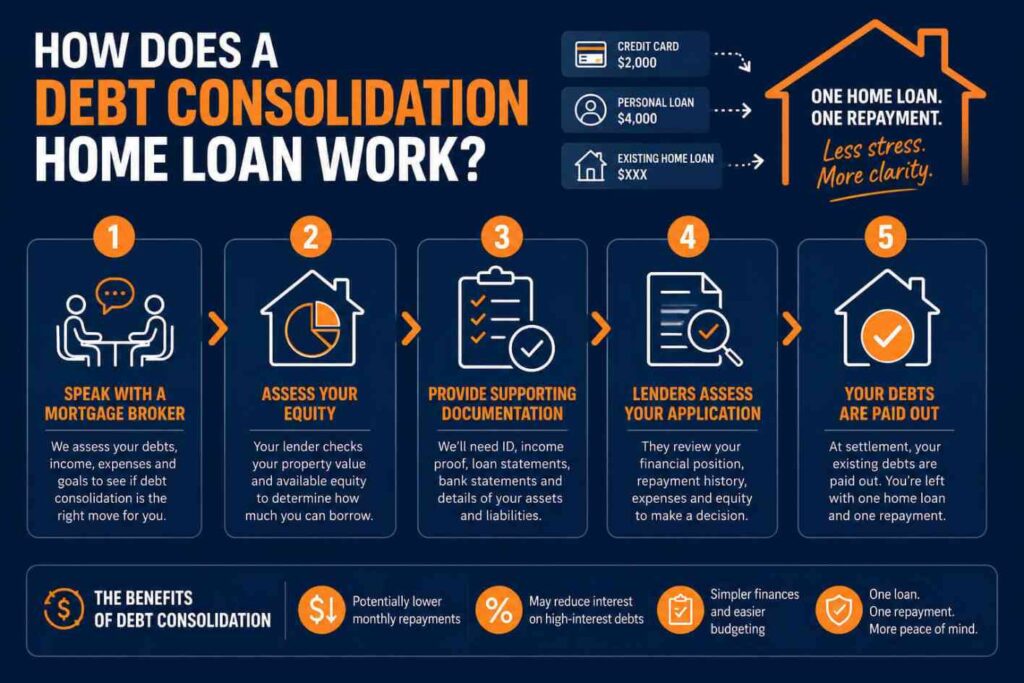
Step 1: Speak With a Mortgage Broker
The first step to make a debt consolidation home loan work is to determine whether it is even the right solution for your circumstances.
When I work with clients, I don’t simply look at whether we can consolidate debts; instead, I look at whether we should. We review their current debts, monthly repayments, income, living expenses, available equity and long-term financial goals to determine whether refinancing is likely to improve their overall financial position.
In some cases, debt consolidation can significantly simplify a client’s finances, while in others, there is always a more suitable strategy available. Your mortgage broker will help you understand just that.
Understand your debt to income ratio to find out how much debt you have compared to your income.
Step 2: Assess Your Available Equity
Before approving a debt consolidation refinance, your lender will need to confirm that you have enough equity in your property.
Home equity is the difference between your property’s current market value and the amount you still owe on your mortgage. The more usable equity you have, the easier it may be to consolidate additional debts into your home loan.
To determine whether you have the equity available, the lender will usually arrange a property valuation. Depending on the lender and the property, this can be done electronically or through a physical inspection.
Discover property investment strategies to boost your investment loan returns!
Step 3: Provide Supporting Documentation
Like any home loan refinance, you’ll need to provide documentation that allows the lender to assess your financial position.
While requirements vary between lenders, generally, you will need to provide:
- Proof of Identity
- Recent payslips or proof of income
- Tax returns and Notices of Assessment (if you’re self-employed)
- Recent home loan statements
- Statements for the debts you wish to consolidate
- Bank account statements
- Details of your current assets and liabilities
Rent now with the option to buy the same property later with Australian Rent to Buy Scheme!
Step 4: Lenders Assess Your Application
The lender will review your application to determine whether you can comfortably afford the refinanced loan. They’ll consider everything from your income and employment stability, financial commitments, repayment history and credit profile to your living expenses and the amount of equity available in your property.
One misconception I often hear is that debt consolidation is only for people experiencing financial hardship. In reality, many of my clients have always made their repayments on time. They simply want to simplify their finances, reduce the number of debts they’re managing and potentially lower the amount they’re paying in interest.
Confused whether to rent or buy in Australia? Check out our guide to learn more.
Step 5: Your Existing Debts are Paid Out
Once your refinance is approved, your new lender will generally arrange for the eligible debts being consolidated to be paid out at settlement. After the loan settlement, you’ll have one home loan with one regular repayment to take care of.
For many homeowners, this means greater visibility over their finances and makes budgeting considerably easier. However, it’s equally important to avoid building up new credit card balances after consolidation. Otherwise, you might find yourself carrying both a larger mortgage and a new unsecured debt, which defeats the whole purpose of a debt consolidation home loan.
Secure property without a cash deposit with a deposit bond!
Benefits of Debt Consolidation Home Loan
For the right borrower, consolidating debt into a home loan can provide much more than just a lower interest rate. It can simplify your finances, improve your cash flow and give you a clearer path towards becoming debt-free. Here are some key benefits of debt consolidation:
Lower Interest Rates
One of the biggest advantages of consolidating debt into your home loan is the potential to reduce the interest you’re paying. Credit cards, personal loans and many other unsecured lending products often come with significantly higher interest rates than residential home loans. By refinancing these debts into your home loan, you can replace multiple high-interest repayments with a single loan at a lower rate.
Simple Money Management
Managing several debts can quickly become overwhelming, particularly when each account has a different repayment date, minimum payment and interest rate. Many of my own clients talk about how tiring it is to juggle multiple repayments every month. Debt consolidation allows such borrowers to combine all their repayments into one mortgage with debt consolidation home loans. Having one repayment also gives you a clearer picture of your financial commitments, which can make long-term budgeting much simpler.
Read: Offset Account Vs Redraw: The Core Differences.
Reduced Fees and Charges
Every loan or credit facility may come with its own account-keeping fees, annual fees or ongoing charges. When you pay off multiple debts and replace them with a single home loan, you can reduce some of these ongoing costs. While refinancing can involve establishment costs or discharge fees, consolidating your debts may reduce the number of fees you’re paying each year.
Improved Cash Flow
Because home loans generally have lower interest rates and longer repayment terms, debt consolidation home loans may reduce your total monthly repayment commitments. For several households, this can improve cash flow and create more breathing room in the household budget. Extra cash flow can be used to build an emergency fund, make additional mortgage repayments, invest for the future or simply reduce financial stress.
Find out who pays for your mortgage after divorce!
A Cleaner Path Towards Becoming Debt-Free
One thing you need to remember is that debt consolidation does not eliminate debt but restructures it. For many, however, having one manageable repayment instead of several creates a stronger sense of control over their finances. Borrowers, when consolidating, are able to focus on a single repayment strategy with a clear long-term goal.
When combined with responsible budgeting and avoiding unnecessary new borrowing, debt consolidation can become an important step towards improving your overall financial health and building wealth.

What are the Drawbacks of a Debt Consolidation Home Loan?
While debt consolidation can be an effective way to simplify finances, it’s important to know that it isn’t without risks. Like any financial decision, refinancing should be carefully considered to ensure it improves your long-term financial position, not just your short-term cash flow.
Your Home Becomes Security for the Debt
Perhaps the biggest risk of debt consolidation is that you’re converting your unsecured debt into secured debt. What that means is, your credit cards, BNPL accounts, and personal loans are generally not tied to your home. However, when you refinance these debts into your mortgage, they become a part of a loan that’s secured against your property.
If you experience financial hardship and can’t keep up with your mortgage repayments, your lender has legal rights over the property. While lenders will usually work with borrowers experiencing genuine hardship before taking further action, it’s important to understand that your home is ultimately being used as security for the consolidated debt.
Transfer your existing home loan to a new property with home loan portability.
You Could Pay More Interest Over Time
Although home loans usually offer much lower interest rates than credit cards or personal loans, they also have much longer repayment terms. For example, consolidating a personal loan that would have been repaid over three years into a 25 to 30 year mortgage may reduce your monthly repayments, but it could also increase the total interest paid if you simply make minimum repayments.
Refinancing Costs
Like with any refinance, debt consolidation can also involve costs, and they need to be factored into your decision. Depending on the lender and your circumstances, you may incur expenses like loan establishment or application fees, government registration fees, property valuation fees, settlement or discharge fees and, if applicable, fixed rate break costs.
Your Loan to Value Ratio May Increase
When you add additional debt to your mortgage, your loan to value ratio (LVR) also increases. If your LVR exceeds 80%, you may be required to pay Lenders Mortagge Insurance (LMI), depending on your lender’s policy. LMI can add thousands of dollars to the overall cost of refinancing, so it’s important to understand whether this will apply before proceeding.
Try using our loan to value ratio calculator to find out how much you can borrow against your property without having to pay an LMI.
Doesn’t Solve the Underlying Problem
Debt consolidation restructures your debt, doesn’t remove it. One of the biggest risks I see in consolidation is borrowers consolidating their credit cards into their mortgage, only to start using those credit cards again after settlement. This can leave them with both a larger home loan and a new unsecured debt, placing them in a worse financial position than before.
The most successful debt consolidation strategies are usually combined with a realistic household budget, responsible spending habits and a commitment to avoiding unnecessary new debt.
If you’re a non-traditional earner, try low doc home loans for home loan flexibility and higher accepting rates!
Is a Debt Consolidation Home Loan Possible with a Bad Credit Score?
Yes, it’s possible to refinance and consolidate your debts with a bad credit score, but it can be more challenging. Every lender has different lending criteria, and your credit history is just one of several factors they’ll consider when assessing your application.
While a lower credit score doesn’t automatically mean your application will be declined, it may reduce the number of lenders willing to approve your loan or affect the interest rate and loan features you’re offered.
As a mortgage broker, I’ve worked with several homeowners who assumed they had no options to refinance because of bad credit. In many cases, their credit issues were the result of temporary financial pressure rather than ongoing financial mismanagement. The key is understanding your situation, knowing which lenders may be suitable and presenting your application in the strongest possible way.
How do Lenders Assess Bad Credit?
When reviewing a debt consolidation application, lenders look at much more than just your credit score. They’ll typically assess factors such as your repayment history, the type and severity of any credit issues, your income and employment stability, existing debts and living expenses, home equity, LVR and whether you’ve demonstrated responsible financial behaviour in recent months.
A single missed payment from several years ago will generally be viewed very differently from multiple recent defaults or ongoing arrears. Many lenders place significant weight on your recent financial conduct. If you’ve consistently made your repayments on time over the past six to twelve months, your application may be viewed more favourably than your credit score alone suggests.
Get a guarantor for your home loan to boost your approval chances with a little deposit!
Is a Debt Consolidation Home Loan the Right for You?
A debt consolidation home loan can be an effective way to simplify your finances, but it’s not the right solution for everyone. The key is determining whether consolidating your debts will genuinely improve your financial position over the long term, rather than simply reducing your monthly repayments.
For many Australian homeowners, debt consolidation makes sense when they’re managing multiple high-interest debts such as credit cards, personal loans or Buy Now, Pay Later accounts. Refinancing these debts into a home loan may reduce the number of repayments you need to make each month, lower your interest costs and make it easier to stay on top of your finances.
However, debt consolidation is no quick fix. If the spending habits or financial challenges that led to the debt aren’t addressed, it’s possible to accumulate new debt after refinancing, leaving you with a larger mortgage as well as new credit card or personal loan balances.
Ultimately, debt consolidation isn’t about borrowing more money, but about restructuring your existing debts in a way that supports your financial goals. Before refinancing, it’s worth taking the time to compare your options, understand the costs involved and ensure the strategy is right for your circumstances.
Discover ways to negotiate your home purchase to lock in the best property offers ever.
How Can We Help You?
As an experienced mortgage brokerage based in Brisbane, Nice Loans compares loan options from a wide range of lenders to help find solutions that suit your needs. We explain your borrowing capacity, assess your available equity, calculate the costs involved and guide you through your home loan refinancing from start to finish.
Most importantly, we give honest advice. If a debt consolidation home loan is the right strategy, we help structure your loan to maximise the benefits, but if another option is likely to leave you in a stronger financial position, we’ll do just that.
If you’re considering refinancing, getting a bridging loan, investment loan or a home loan, we’d be happy to discuss your circumstances and help you understand your options. Reach out to us asap!
FAQs
How much does it cost to consolidate your debt?
The cost of debt consolidation varies depending on your lender and the type of refinance. You may need to pay costs like application fees, property valuation fees, settlement costs or discharge fees from your existing lender. If your loan-to-value ratio (LVR) exceeds 80%, you may also need to pay Lenders Mortgage Insurance (LMI), depending on your circumstances.
Who qualifies for a debt consolidation home loan?
Eligibility depends on several factors, not just your credit score. Lenders will typically assess your income, employment, repayment history, available equity, living expenses, existing debts and overall borrowing capacity. They’ll also consider whether you can comfortably afford the refinanced loan.
Even if you’ve experienced credit issues in the past, you may still have options depending on your current financial position and the lender’s policies.
When is the right time to consider a debt consolidation home loan?
The right time to consolidate your debt depends on your financial circumstances rather than how long you’ve had your mortgage. Some lenders may require you to wait before increasing your loan, while others may allow you to refinance or access equity much sooner, provided you meet their lending criteria.
Generally, debt consolidation is worth considering when you have sufficient equity in your property, stable income and multiple high-interest debts that are becoming difficult to manage. Speaking with a mortgage broker can help you determine whether now is the right time to refinance.
Will debt consolidation improve my credit score?
Debt consolidation itself doesn’t automatically improve your credit score. However, paying off existing debts, reducing your credit card balances and consistently making your home loan repayments on time may have a positive impact on your credit profile over time.