
Buying a home is one of the biggest financial decisions many of us will ever make. Yet several buyers enter the property market without professional representation, where sellers are almost always backed by real estate agents, home buyers often seem unaware of the parties that can be by their side. This is where a buyer’s agent can play an important role.
Our guide here will explain to you exactly what is a buyer’s agent, how they work, what they cost and whether hiring one is worth considering in today’s Australian property market!
Rent where you love while investing where you can afford by rentvesting!
What is a Buyer’s Agent in Australia?
A buyer’s agent is a licensed property professional who represents the interests of the buyer throughout the purchasing process. Also known as a buyer’s advocate, the buyer’s agent is responsible for serving exclusive allegiance to the buyer.
Unlike a selling agent who is engaged by the vendor to achieve the highest possible sale price, a buyer’s agent works to help clients identify suitable properties, conduct research, assess market value, negotiate with selling agents and overall assist in securing a property in favourable terms. Simply put, a buyer’s agent is your professional representative in a property transaction.
Buying a second home? Check out our guide to understand why assessing your borrowing capacity and financial goals makes all the difference!
Who Does a Buyer’s Agent Work for?
As a buyer’s agent is engaged by the buyer, they are also rightfully paid by the same. It is their legal and professional obligation to act in the buyer’s best interest throughout the transaction.
Independent buyer’s agents are expected not to receive commissions, referral payments or incentives from property developers, builders or selling agents.
Since transparency is key when choosing any property professional, potential home buyers need to understand the agent’s business model and confirm whether they receive any third-party payments that could influence their recommendation.
Did you know it was possible to purchase property through a trust?
What Does a Buyer’s Agent Do?
The service provided by a buyer’s agent can vary depending on the buyer’s needs. While some clients employ a buyer’s agent solely for negotiation, others opt for a full-service package that encompasses every stage, from property search to acquisition. The following are some common responsibilities:
Developing a Property Strategy
A good buyer’s agent begins by understanding your goals. This includes assessing your budget and borrowing capacity, what the purpose of your purchase is, whether you’re buying for yourself or an investment, your lifestyle requirements, risk tolerance, timeframes and long-term property plans.
If you are a property investor, your agent is set to analyse factors such as population growth, infrastructure investment, vacancy rates, rental demand, potential rental yield and historical market performance to bring you options that are bound to generate maximum returns.
Rather than chasing media headlines or the latest hot suburbs, experienced buyer’s agents focus on identifying areas supported by strong fundamentals, those that can actually support the buyer’s lifestyle.
Lower mortgage interest by linking your savings to your home loan with offset accounts.
Finding Suitable Properties
When you’re looking to buy real estate, the property search is one of the most time-consuming parts. Here, a buyer’s agent can help you search for listed properties, identify off-market opportunities, filter unsuitable properties, arrange inspections and shortlist properties that align with your goals.
All of the things that could have taken you ages become easy with a buyer’s agent taking care of them for you. For interstate investors, busy professionals and buyers entering unfamiliar markets, this is truly a dream come true.
Work on improving your credit score for loan approval and better interest rates.
Conducting Due Diligence
You should know that not every property that looks appealing online represents a good purchase. This gullible act of believing everything on the internet costs people millions; you do not want to be one of them.
To avoid such circumstances, a buyer’s agent may assist with all property purchase dealings, from reviewing comparable sales, assessing market value, identifying property risks, reviewing location fundamentals, to coordinating building and pest inspections, and examining contract conditions.
Getting a buyer’s agent’s help ensures that buyers make decisions based on evidence rather than emotion.
Find out how to get a home loan if you’re self-employed to land a flexible home loan solution!
Negotiating the Purchase
Negotiation is where experienced buyer’s agents provide significant value. As technical and professional as property transactions can be, they’re inherently emotional too. Buyers can easily become attached to a home and feel pressure to stretch their budget, but a buyer’s agent acts as an objective third party who can communicate better with selling agents and present offers strategically.
Not only that, but they can also negotiate purchase terms, represent buyers at auctions, and reduce the overall likelihood of overpaying. Because they negotiate regularly, buyer’s agents understand how selling agents operate and can help buyers navigate competitive situations more effectively.
Understand loan to value ratio to determine your borrowing amount and interest rates.

How a Buyer’s Agent Can Help
As mortgage brokers, we often see buyers become psychologically invested in a property so much so that they’re willing to offer beyond what the market supports.
Recently, I worked with a client purchasing their first home in Brisbane. After losing several properties in competitive bidding situations, they finally chose to engage a buyer’s agent, and it turned out to be the best decision of their journey.
Confused between owner occupied vs investment loans? Find out the perfect choice for you!
The buyer’s agent identified a property that had been overlooked by several buyers simply because of some presentation issues. And the next thing you know, through market research and negotiation, the property was secured below the client’s maximum budget.
The savings not only reduced their loan size but also left additional funds available for renovations after settlement. While it is true that every purchase is different, examples like these demonstrate exactly how professional guidance can influence outcomes.
How Do Buyers’ Agents Get Paid?
Money runs the world. Understanding a buyer’s agent’s fee structure is important before entering into any agreement, as it helps you evaluate the value being provided and ensures there are no surprises throughout the property search process.
Check Out: Understanding Debt to Income Ratio in Australia.
Fixed Fee
Under a fixed-fee model, the buyer pays a predetermined amount regardless of the property’s purchase price.
Find out how mortgage works after your divorce!
There are various benefits of going with this model of payment, including:
- Clear cost transparency
- Easier budgeting
- No financial incentive to recommend more expensive properties
- Predictable fees from the outset
Whether your buyer purchases a property for $700,000 or $1 million, the agreed fee remains the same. Many buyers appreciate the simplicity and transparency of this approach.
Figure out your stamp duty for accurate estimates before buying.
Percentage-based Fee
Some buyer’s agents charge a percentage of the final purchase price. This generally ranges between 1% and 3%, depending on the service provided.
Let’s say a buyer’s agent charges 2% and secures a property for $800,000, then, according to this structure, the fee would be $16,000.
One thing to keep in mind is that some agencies can also have minimum fee thresholds, meaning a percentage calculation may not apply below a certain purchase price.
Before an agent is engaged, buyers need to understand how the fee is calculated, whether minimum fees apply, what services are included and whether additional costs may arise for auctions or specialised searches.
All in all, while a fee structure is important, it should not be the only factor considered when selecting a buyer’s agent. The cheapest option is not always the best value, and the highest fee does not automatically indicate superior service.
Rent now with the option to buy later with rent to buy schemes!
When Does Using a Buyer’s Agent Make Sense?
One thing to understand is that not every property purchaser needs professional representation. However, there are certain situations where a buyer’s agent can be especially helpful.
The Australian property market can be complex, competitive and challenging. Whether you’re buying your first home, investing for the future, or juggling a busy career, having an experienced professional on your side can help simplify the buying process and reduce costly mistakes.
Reduce taxable income by allowing deductions through investment property depreciation.
Are You Buying Your First Home?
Purchasing your first home can be a very exciting and nerve-wracking experience, both at the same time. Most first home buyers only purchase property once or twice in their lifetime, meaning they have limited experience assessing market value, understanding negotiation tactics or identifying potential issues with a property.
Here, a buyer’s agent can help them understand the market conditions, avoid overpaying, identify potential risks and navigate the entirety of the purchasing process with confidence.
We have met with various first-home buyers who had formerly missed out on wonderful property opportunities, but after engaging with a buyer’s agent, they gained a clearer understanding of comparable sales and pricing strategies.
Low-income home loans offer flexibility with easier criteria and low deposits. Try now!
Are You a Property Investor?
Successful property investment is rarely about buying the property receiving the most media mentions. What is gaining momentum online might not be able to garner real-life appreciation.
Long-term investment success can only be achieved by following a clear strategy, understanding market basics and making decisions based on research rather than speculation.
A buyer’s agent can assist investors by identifying suburbs with strong fundamentals, analysing demand and supply trends, reviewing vacancy rates and rental demand, and assessing overall opportunities that align with your investment objectives.
Keep your current home loan while moving properties with home loan portability.
Don’t Have Much Free Time?
Many buyers simply don’t have the time to conduct property searches, and if you are one of them, a buyer’s agent can help you do everything from researching suburbs, monitoring listings, attending inspections, to reviewing contracts and negotiating with agents.
This allows buyers to remain focused on their work and personal commitments while still progressing towards their property goals.
To reduce tax liability while purchasing your new home, try salary sacrifice home loans!
Buying Property in Another State?
Interstate property purchase presents additional challenges. Without local knowledge, buyers can struggle to understand the neighbourhood dynamics, pricing trends, infrastructure projects and future growth prospects.
A buyer’s agent with local market expertise can provide on-the-ground insights and represent buyers who cannot regularly inspect properties themselves. This is particularly common among investors purchasing in growth markets outside their home state.
Read: Offset Account Vs Redraw: The Core Differences.
Reasons Australians Might Use a Buyer’s Agent
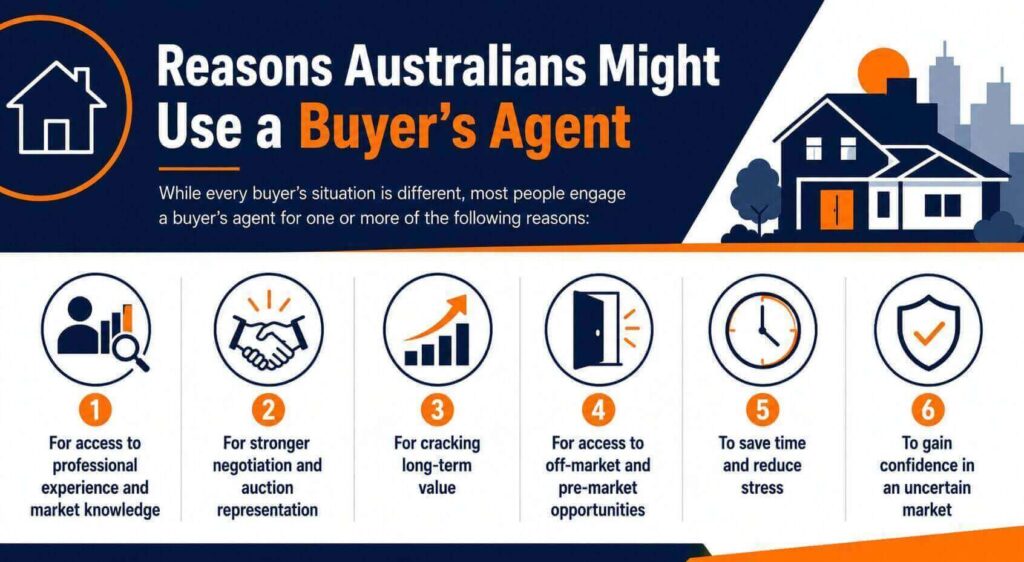
While every buyer’s situation is different, most people engage a buyer’s agent for one or more of the following reasons:
- For access to professional experience and market knowledge
- For stronger negotiation and auction representation
- For cracking long-term value
- For access to off-market and pre-market opportunities
- To save time and reduce stress
- To gain confidence in an uncertain market
Pay off your mortgage faster by making extra repayments or switching to fortnightly payments!
Is the Value Worth the Cost?
Whether a buyer’s agent represents good value ultimately depends on your individual circumstances. Experienced buyers who have strong market knowledge and plenty of time may feel comfortable managing the process independently, but for certain people, the expertise, time savings and support provided by a buyer’s agent can outweigh the cost of engaging one.
Ultimately, the key is not simply finding a buyer’s agent but finding the right buyer’s agent, one that is experienced, transparent and aligned with your property goals.
Fund your self-managed build in stages with owner-builder home loans!
Things to Consider Before Hiring a Buyer’s Agent
While a buyer’s agent can provide valuable expertise, save time and help buyers navigate a complex property market, like any professional service, it’s still important to do your own research before deciding who to engage.
While many buyers have positive experiences working with buyer’s agents, there are no guarantees when it comes to property investing, capital growth or securing a property below market value. Before you sign a buyer’s agency agreement, consider the following factors.
Use your super for your first home deposit!
Conflicts of Interest
One of the biggest advantages of working with a buyer’s agent is having someone represent your interests throughout the purchasing process.
However, not all buyer’s agents operate under the same business model. Some agents work independently and are paid solely by their clients, while others may have relationships with real estate developers, project marketers or third-party referral partners.
A reputable buyer’s agent is transparent about their operations. Therefore, make sure to only trust those who can be trusted.
Also Read: How Much House Can I Afford?
Understanding the Fee Structure
As mentioned before, not all buyer’s agents charge fees the same way. Neither the fixed fee nor the percentage-based charge is inherently right or wrong, but it’s important to understand exactly how the fee structure works before agreeing.
Rather than focusing solely on cost, consider the overall value being offered, including experience, market knowledge, communication and the level of support provided.
Try no deposit home loans to buy with zero upfront savings!
Licensing and Qualifications
Even if property regulations vary between Australian states and territories, buyers’ agents are generally required to hold appropriate licenses or registrations to operate legally.
Before you get into a deal with any agent, verify that they meet the licensing requirements in the state where you are purchasing property.
A buyer’s agent with experience and a licence is more likely to understand relevant legislation, negotiation processes and market dynamics.
Turn your home loan debt into tax deductible debt by debt recycling.
Reviews and Reputation
Before engaging a buyer’s agent, take the time to research their reputation. Look beyond marketing claims and seek evidence of real client outcomes. Consider everything from online reviews, independent testimonials and case studies, to referrals and recommendations from friends or family.
A strong track record does not guarantee future results, but it can provide useful insight into how an agent works with clients and the level of service they provide.
Real Estate Agents vs Buyers Agents
If you have ever thought that the real estate agent showing you the property is working on your behalf, you are so wrong. In reality, real estate agents and buyer’s agents perform very different roles and represent completely different interests throughout a property transaction.
Buy a new home before selling your current one with bridge loans!
The simplest way to spot the difference between the two is to look at who each professional is employed to represent. A real estate agent, also known as a selling agent, is engaged by the property owner to market and sell their property. A buyer’s agent, on the other hand, is engaged by the purchaser.
| Buyer’s Agent | Real Estate Agent |
| Represents the buyer | Represents the seller |
| Paid by the buyer | Paid by the seller |
| Helps buyers find suitable properties | Helps sellers market properties |
| Negotiates for the buyer | Negotiates for the seller |
| Focuses on securing the best possible value for the buyer | Focuses on achieving the highest possible sale price |
| Conducts research and due diligence | Promotes the property to potential buyers |
| May source off-market opportunities | Generates buyer competition |
While both work within the property industry, they are effectively operating on opposite sides of the transaction.
Secure property without an upfront home deposit easily by using deposit bonds!
Do You Need a Buyer’s Agent If There’s Already a Real Estate Agent Involved?
This is a very common query, and the answer is technically no. Many Australians successfully buy a property without engaging a buyer’s agent.
However, it’s important to understand that the real estate agent involved in the transaction will not provide independent advice to the buyer. While some purchasers can comfortably handle property processes on their own, some require help. In the end, whether a buyer’s agent is worthwhile despite there being a real estate agent involved depends on your experience, confidence, availability and market familiarity.
Access home equity without selling with a reverse mortgage and home equity release!
The Pros of Using a Buyer’s Agent
Potential advantages of using a buyer’s agent include:
- Access to market knowledge
- Time savings
- Access to Additional opportunities, ones that are not widely advertised.
- Reduced emotional decision-making
You Might Be Interested In: Negative Gearing vs Positive Gearing: Pros and Cons.
The Cons of Using a Buyer’s Agent
While buyer’s agents can add value, they are not suitable for everyone. Potential drawbacks of using a buyer’s agent are:
- Additional cost
- Varying quality
- No guaranteed outcome
With the Australian Help to Buy Scheme purchase your dream home at just 2% deposit!
Common Misconceptions About Buyer’s Agents
Buyer’s agents are widely misunderstood despite their increasing popularity. Several property buyers have preconceived ideas about who uses buyer’s agents, what they do and whether they provide any genuine value. Let’s debunk some of the most common myths surrounding buyer’s agents and the reality behind them.
Understand home loan approval to meet lender conditions better!
Buyers’ Agents are Only for the Wealthy
One of the most common misconceptions is that buyer’s agents are exclusively used by wealthy individuals purchasing luxury homes. While high net worth buyers often engage buyer’s agents, they are far from the only people using these services.
In reality, buyer’s agents frequently work with first home buyers, young families, everyday property investors, interstate purchasers and more.
Are you a non-traditional income earner? Low doc home loans are just what you’re looking for!
Buyers’ Agents are Unnecessary
Many buyers believe negotiation is simply a matter of making an offer and waiting for a response. Therefore, they think that anyone can negotiate, and a buyer’s agent is only an unnecessary hassle.
However, a buyer’s agent brings an entirely different perspective into the home-buying process. From analysing comparable sales data to advising buyers during bidding at auctions and competitive campaigns, they help maintain discipline and focus on facts rather than just emotion and feel.
Did you know that you could refinance your home loan even with bad credit?
Buyers’ Agents Only Provide Access to Off-Market Properties
Although off-market properties receive significant attention in property discussions, leading many buyers to believe this is the primary reason to hire a buyer’s agent. The reality is that off-market access is often just one component of the service.
The real value of using a buyer’s agent lies in helping buyers choose the right property and avoid the wrong one. While access to off-market or pre-market opportunities can be beneficial, it should generally be viewed as an additional advantage rather than the core reason for engaging a buyer’s agent.
Get a guarantor for your home loan to avoid lender’s mortgage insurance and boost borrowing power.
All Buyer’s Agents Are the Same
Just like mortgage brokers, accountants or financial advisers, not all buyer’s agents offer the same level of expertise or service. Experience, local market knowledge, research capabilities and professional networks can vary significantly between agencies.
Choosing the right buyer’s agent can be just as important as deciding whether to use one at all.
Buy with a low deposit and zero LMI with the Family Home Guarantee Scheme!
How to Find a Buyer’s Agent?
One of the best ways to begin your search is by speaking with people you trust, friends, family members, colleagues and professional advisers who have recently purchased property. These people have first-hand experience in dealing with all matters related to property purchase, and therefore, can be the perfect support.
Before engaging any buyer’s agent its necessary to ensure that they hold appropriate licenses and registrations required in the state or territory where you intend to purchase. You need to ask whether they belong to any recognised industry associations or professional organisations that prove dedication and commitment to their dealings.
Get a home loan pre-approval to determine your borrowing capacity!
A reputable buyer’s agent should also clearly explain their fee structure, their services, any additional costs and the date of the payment due. Transparency around fees is essential.
One of the most important questions to ask is whether the agent acts solely for the buyer. Since some maintain relationships with developers, project marketers or third-party referral partners, it’s fair for you to want to confirm if agent recommendations could potentially be influenced by their relations.
With all your queries answered, schedule an initial consultation where you can review the buyer’s agency agreement in detail. You can discuss your property goals, budget, borrowing capacity, and preferred locations to finally come to a conclusion.
Finding the right buyer’s agent requires more than simply choosing the first name that appears online. The best buyer’s agents combine their expertise with a genuine commitment to representing their clients’ needs. Always remember how big a role your buyer’s agent is set to play and invest the time to choose carefully.
Refinance your home loan to get the best rates and loan features.

Do You Need a Buyer’s Agent?
Whether or not a buyer’s agent is the choice for you is entirely an independent decision. Regardless of how having one or not affects your property purchase journey, you are the one who needs to be at ease, so you need to make that choice.
A buyer’s agent works exclusively for you, helping you navigate the market with clarity while bringing objectivity and discipline to a process that can often be driven by pressure. If you believe assistance would prove beneficial, there you go, that is your answer.
At Nice Loans, your trusted home loan specialist based in Brisbane, we understand that buying a home is much more than buying the right property. If you need help with financing and loan structuring, you know exactly where to find us!
FAQs
Is a Buyer’s Agent Different from a Buyer’s Advocate?
No, in Australia, the terms ‘buyer’s advocate’ and ‘buyer’s agent’ are generally used interchangeably.
What is a Buyer’s Agent Fee?
The agent fees vary depending on the service offered. Most buyer’s agents charge either a fixed fee or a percentage of the property’s purchase price.
Do Buyer’s Agents Have Access to Off-Market Properties?
Some buyer’s agents have access to off-market or pre-market opportunities through industry relationships. However, it is an additional benefit rather than a primary one.
Can a Buyer’s Agent Attend Auctions on My Behalf?
Definitely. Many buyer’s agents offer auction bidding services and can represent buyers during auction campaigns.