
Real estate has been and will be one of the most trusted ways to build capital and long-term wealth. Property investment in Australia continues to attract both new and experienced investors. However, while the rewards can be significant, entering the property market also comes with risks, thus requires careful planning and strategy.
When you invest in real estate, you benefit not only from potential capital growth but also from a steady rental income. For several Australians, property investment is a go-to method for securing financial stability. That’s why having a clear plan and understanding your financing options is essential.
Find out how much you need to borrow in context to your property value through LVR calculation.
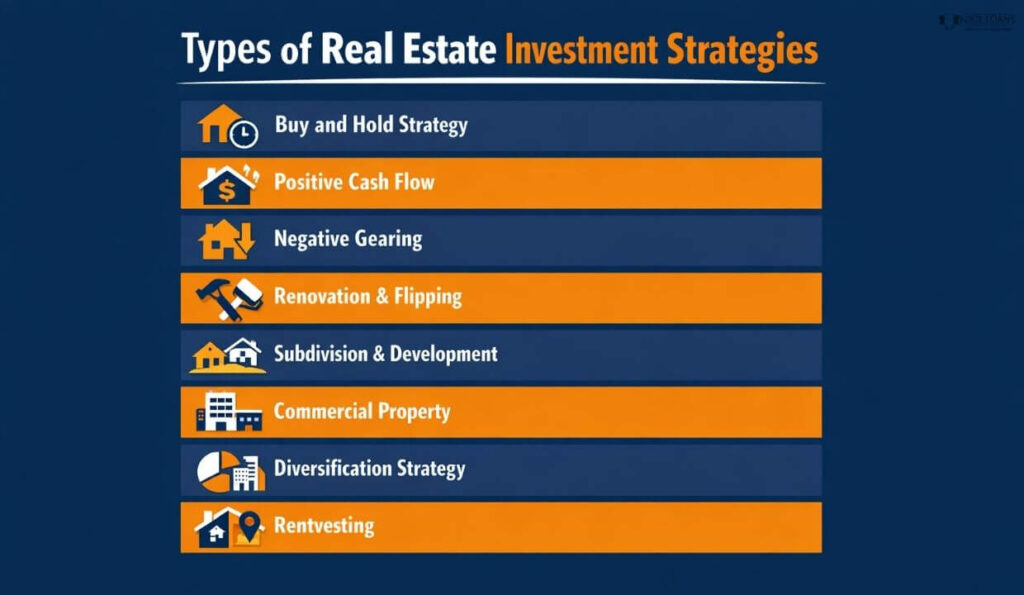
Types of Real Estate Investment Strategies
According to your financial circumstances, property investment strategies can differ. There is no one-size-fits-all approach for real estate financing. The right strategy contains considerations for risk tolerance and long-term stability.
If you are looking to secure a loan for investing in Australia, understanding these strategies will help you maximise returns and minimise risk.
Discover ways to negotiate your home purchase to lock in the best property offers ever.
Want to find out how much you can borrow and set your home-buying budget? Consider getting a home loan pre-approval to navigate your home-buying journey with confidence!
Buy and Hold Strategy
The buy-and-hold approach is one of the most widely used strategies in property investment, particularly for those who focus on long-term wealth creation through capital growth. This strategy involves purchasing an available property and holding it over an extended period to benefit slowly.
For the best results, investors are advised to target properties in high-demand locations with strong infrastructure, population growth and access to amenities such as schools, transport and various retail hubs.
Home loan portability is just what you need to keep your existing mortgage while changing properties!
Here, your rental income helps cover mortgage repayments, property management fees and ongoing expenses, making a reliable form of passive income, all while being supported by the right investment property financing.
However, as reliable as the hold-to-buy strategy is, it does not come without risks. Property values can grow and fall depending on market conditions. Additionally, ongoing costs such as council rates, insurance, maintenance, and interest on your loan for investment in Australia remain regardless of rental performance.
Did you know that it was possible to pay off your mortgage in only 10 years? Learn how to with our piece on how to pay off your mortgage faster!
Positive Cash Flow
Are you someone who prioritises steady income over long-term capital growth? Then the positive cash flow strategy is just the pick for you.
Positive cash flow occurs when the rental income generated from a property exceeds all associated expenses, including mortgage repayments, interest on your loan, property management fees, maintenance and insurance.
For those looking to invest in property in Australia, this strategy focuses on generating consistent income that can support everyday living expenses or be reinvested into additional properties.
Achieving positive cash flow requires careful property selection, accurate cost analysis and well-structured investment property financing. It is important that you evaluate all ongoing costs to ensure that the property will stay profitable over time.
Wish to build your own home but lack the funds for it? The Owner builder home loan is just the match for you!
Negative Gearing Strategy
If you have ever considered investment in real estate in Australia or elsewhere, you should have heard of negative gearing. It is a strategy that focuses on long-term capital growth rather than immediate income.
Negative gearing occurs when the total costs of owning a property, such as mortgage interest, property management fees, maintenance and other expenses, exceed the rental income it generates. This results in a short-term financial loss, which can often be offset through investment property tax deductions, helping to reduce your overall taxable income. Several investors choose this strategy with the expectation that the property will increase in value over time.
When structured correctly, negative gearing can be an effective way to access higher-value properties while managing short-term cash flow through tax benefits and strategic investment financing.
You can buy an investment property with just your super. Discover more about SMSF loans right now!
Renovation and Flipping
The renovation and flipping strategy focuses on generating short-term profits rather than long-term holding. It involves purchasing undervalued or outdated properties for investors, improving them through renovations and reselling at a higher price.
For those looking to invest in real estate Australia, this strategy offers the opportunity to directly increase a property’s value. Success depends on buying well, managing renovation costs effectively and timing the market correctly.
However, before you begin, it’s essential to budget for all expenses, including renovation costs, holding and agent fees, as well as stamp duty. A contingency buffer is highly recommended to cover unexpected issues.
With the renovation and flipping strategy, you can strengthen your property investment portfolio in no time. Remember to choose the right investment financing structure and seek professional advice to manage risks effectively.
Are you self-employed and looking for a loan that offers more application flexibility? Low-doc home loans are made just for you!
Subdivision and Development
Okay, this one’s a little more advanced. Subdivision and development is a property investment strategy that is designed to maximise the value of land and significantly increase returns. This strategy involves either subdividing a single block into multiple lots or constructing additional properties such as townhouses or units to boost both resale and rental yield.
If you are looking to invest in property on a large scale, this method offers the opportunity to create multiple income-generating properties from a single purchase.
Here, you need to make sure that the location you choose is in high-demand, with strong infrastructure, a growing population and access to amenities. It’s also crucial to avoid overcapitalising by ensuring your development perfectly fits the area’s pricing range and demand.
Read: Lenders Mortgage Insurance (LMI): Everything You Need to Know
Commercial Property Investment
Commercial property investment, as the name suggests, focuses on assets like offices, retail shops, and industrial warehouses. Compared to residential properties, commercial investments are known to lend higher rental yields, longer lease terms, and more predictable income streams, making them an attractive option.
Commercial properties can serve as a reliable source of income while offering opportunities for long-term capital growth. For those seeking stability and a lower turnover, commercial property investment is a great option.
Access your home equity without selling with reverse mortgages and home equity release.
Diversification Strategy
The diversification strategy reduces risk by spreading investments across different property types, locations and markets. By combining all these types, investors can protect themselves against market fluctuations and capitalise on multiple income streams.
Here, you can balance high-growth properties with stable assets such as positive cash flow residential properties or commercial real estate. Not just that, it also enables you to utilise different financing options and take advantage of investment property tax deductions across your portfolio.
Remember to regularly review your loan to ensure that your financing continues to support your investment goals without overexposing you to risk. Work with a financial advisor, a property investment specialist, a lending specialist or an experienced mortgage broker to ensure that your portfolio is well-structured and you’re connected to good lenders.
Secure your chosen property without an upfront deposit with Deposit Bonds!
Rentvesting
Rentvesting is an increasingly popular strategy in property investment Australia, allowing investors to enter the property market without compromising their lifestyle or preferred living location. You continue to remain where you are while purchasing an investment property in a more affordable or high-growth area.
This approach enables you to build equity and grow your portfolio over time, taking advantage of investment property financing options and potential investment property tax deductions. For those looking to invest without relocating, rentvesting sets the perfect balance between lifestyle preservation and wealth creation.
Investors are advised to attentively manage mortgage repayments on the investment property, ongoing maintenance costs and potential vacancies. With careful planning, rentvesting can also serve as a stepping stone to acquiring additional properties for investors and generate massive returns.
Try the Australian Help to Buy Scheme and buy your dream property at just 2% deposit!
Benefits and Risks of Using Loans for Property Investment
Real estate investment is one of the most effective wealth-building techniques in Australia. By choosing the right loan for investment and understanding its advantages and potential risks, investors can leverage their capital to grow a rounded investment portfolio, generate consistent income and maximise returns.
Discover the difference between conditional and unconditional approval to meet home loan conditions and settle faster than ever!
Benefits
- Tax Benefit: Most investment loans come with tax-deductible benefits. Interest repayments on your investment property financing can often be claimed against rental income, reducing your taxable income and increasing your net returns.
- Leverage to Grow Faster: Investment loans allow you to purchase properties with less upfront capital. By leveraging borrowed money, you can spread your capital across multiple investments, accelerate portfolio growth and maximise potential returns.
Did you know that you could cut your home loan interest by thousands with offset accounts or a redraw facility? Try now to unlock unlimited benefits!
- Access Diversified Investments: Using loans strategically can help build a diversified portfolio, including residential, commercial, and development properties. Incorporating real estate income trusts can further expand your investment reach without heavy upfront capital.
- Increased Purchasing Power: Loans enable investors to acquire higher-value properties or multiple properties for investors that might otherwise be out of reach. The flexibility allows you to act quickly in hot markets or take advantage of undervalued opportunities in regional growth areas.
Use our property selling cost calculator to find out how much you need to sell your property!
- Cash Flow Flexibility: Strategic investment property financing options, such as interest-only loans, can help manage short-term cash flow while focusing on long-term growth.
Get a guarantor for your home loan to utilise a portion of their equity to provide additional security for your purchase.
Risks
- Unreliable Market Conditions: Property values can rise or fall depending on market conditions. A downturn may reduce capital growth, rental demand, or resale potential, impacting your ability to service a loan.
- High Borrowing Costs: Investment property financing often carries higher interest rates and fees compared to standard residential loans. These costs can erode rental income and overall returns if not managed carefully.
Find out how salary sacrifice affects your home loan application!
- Debt Obligations: Loans come with fixed repayment commitments regardless of property performance. Missed payments can result in penalties, higher interest rates or foreclosure.
- Interest Rate Increases: Rising interest rates can increase repayment costs on your loan for investment in Australia, reducing cash flow and overall returns.
- Potential Negative Equity: If property values decline, you may owe more than the property is worth. Negative equity can limit your ability to refinance, sell or expand your property portfolio.
Also Read: Understanding Debt to Income Ratio in Australia.

Expert Tips to Become a Property Investor in Australia
Becoming a successful investor in the property investment market may seem out of reach at first, but with the right knowledge and strategy, it is far more achievable than most people might think. Whether you’re only starting out or looking to expand your portfolio, understanding the fundamentals of property investment can help you confidently take the first step.
Get a buyer’s agent to help you find suitable properties in your budget!
Several first-time investors hesitate because they believe they lack the funds, feel overwhelmed by the process or think they are too young to begin. However, with access to the right investment strategy and a clear plan, entering the property market is not a difficult feat.
Did you know that you could buy a home without any upfront savings? No deposit home loan options offer quick access into the property market with zero deposit required!
Understand All Property Investment Components
To successfully invest in real estate Australia, it’s important to understand exactly what drives the positive returns. The concept of capital growth, cash flow, tax benefits and leverage should be practically ingrained in your brain. A strong property investment strategy balances these components without having one overpower the other.
You might be interested in: Refinancing a Home Loan with Bad Credit.
Choose the Right Location
Location remains one of the most critical factors of successful property investment in Australia. Properties in areas with strong infrastructure, population growth and access to essential amenities tend to outperform those in relatively quiet areas.
When you select a location, consider proximity to schools, public transport and employment hubs. Having planned infrastructure and future development projects at hand can encourage renters or buyers to get involved.
Try first home buyer grants and schemes to eliminate thousands off your first home purchase!
Choose the Right Property to Buy
Different property types attract different tenant groups. Where houses are ideal for families and deliver strong capital growth with long term stability, apartments and units are popular among young professionals and students. Understanding your target and signing your purchase with market demand will improve occupancy rates and overall returns.
Are you a single parent trying to purchase a home but are unable to fund your deposit? With the family home guarantee scheme, you can become a homeowner with only 2% deposit and zero LMI!
Think long-term and Stay Consistent
Successful property investment is not about quick wins, it’s more about patience, discipline and consistency. Property markets move in cycles, and long-term ownership is often the key to maximising returns.
By focusing on high-quality assets, maintaining a sustainable investment property financing strategy and leveraging investment property tax deductions, you can steadily build wealth and financial security over time.
Consistency is everything; you need to keep going. The earlier you begin, the more time your investments have to grow. Start now!
Rent now with the option to buy later with Australian rent to buy schemes!
Structure Your Financing Well
Choosing the right loan for investment is just as important as selecting the property itself. A well-structured investment property financing plan can improve cash flow, reduce risk, and support long-term portfolio growth.
Consider factors such as interest rates, loan structure, borrowing capacity and flexibility. Smart financing decisions can help you acquire more properties for investors and grow your property investment portfolio faster.
Read: How Much House Can I Afford?
How to Qualify for an Investment Loan?
Qualifying for an investment loan is a crucial step in building a successful property investment portfolio. While requirements can vary between lenders, several key factors that most lenders will assess before approving your application are as follows:
- Investment Planning: A clear investment plan can strengthen your application by outlining your expected rental income, capital growth potential, and your overall investment strategy.
- Your Financial Position: Your financial profile is one of the most important factors when applying for investment property financing. Lenders will look into your credit score and history, your existing debts and liabilities, as well as your savings and overall financial health. Having a good credit score can help you secure better interest rates and loan terms.
- Property Valuation: Lenders evaluate the property itself as part of your application. This includes assessing whether the asset is a suitable investment and likely to generate income or capital growth.
- Documents Verifying Income: Lenders need assurance that you can consistently meet loan repayments. You’ll need to provide payslips or proof of employment, tax returns and bank statements, rental income statements if applicable and business financials if self-employed. Stable and reliable income increases your borrowing capacity and improves the chances of loan approval.
- Deposit Requirements: Investment loans generally need larger deposits compared to owner-occupied home loans. Typically, you need a 20-25% deposit for residential properties and up to 40% deposit for commercial properties. Make sure you have the optimal amount prepared before you apply.
- Borrowing Capacity and Loan Structure: Lenders will also assess your borrowing capacity based on your income, expenses and existing debts. Choosing the right loan structure is vital for long term success in the property investment industry.
How to Choose the Right Loan for Your Investment?
Selecting the best loan for your investment depends on several key factors:
- Your Investment Timeline: Your investment timeline plays a major role in determining the most suitable loan type for you. Short-term investments can benefit from bridging loans and short-term finance; however, long-term investments are better suited to stable, low-interest loan structures.
Qualify for a trust home loan to transfer wealth between generations at ease!
- Match the Loan to Your Property Type: The type of property you’re purchasing will influence your loan choice when you invest in real estate. Go for standard investment loans if you’re purchasing residential properties, and look for more specialised loans if it’s commercial properties.
- Understand Your Cash Flow Needs: Cash flow is a key consideration when choosing investment property financing. Interest-only loans can reduce monthly repayments, improving short-term cash flow, while principal and interest loans help build equity over time but come with higher repayments.
Try linking your transaction account with your home loan to reduce the interest on your mortgage with Offset Accounts.
- Understand Interest Rates and Costs: Interest rates can vary significantly depending on the loan type and lender. For long term investment loans, you’re typically offered lower rates, and for short-term high-risk loans, you’re asked for higher interest and fees. Compare these costs and ensure that the decision supports your long-term financial goals.
- Compare Loan Terms and Conditions: Not all loans are created equal, so it’s essential to carefully compare your interest rates, repayment conditions, fees and charges and the flexibility of your loan.
- Choose the Best Lender or Broker: Working with the right lender is just as important as choosing the right loan. Experienced lenders or mortgage brokers who specialise in property investment can tailor loan structures to your investment strategy and help you access better rates and terms.
Investment Property Tax Deductions
One of the biggest advantages of property investment is the ability to claim a wide range of investment property deductions. These deductions can significantly reduce your taxable income and improve the overall return on your investment.
Reduce taxable income by allowing deductions through investment property depreciation.
If you invest in real estate in Australia, any expenses directly related to earning rental income may be tax-deductible. Understanding and maximising these deductions is essential for building a profitable portfolio of properties for investors.
Investment property owners can typically claim deductions on mortgage interest, property management fees, repairs and maintenance costs, insurance premiums, depreciation on the building and assets and more. Among these, interest on your loan is often the largest and most impactful deduction.
Turn your home loan debt into tax-deductible debt by debt recycling!

The key to achieving successful returns on your property investment depends on the plans you have made to achieve the said goal. From financing for investment to fulfilling the purpose of the investment, every step of the process requires a vision.
For tailored guidance on investment property financing, reach out to Nice Loans, the best home loan solution in the market, to help you navigate your options and make confident decisions aligned with your financial goals.