Homes are made of dreams, and building your own home can be one of the most rewarding undertakings ever. While it is a big responsibility, it comes with complete control over design, functionality and finishing of your property. Owner-builder loans are specifically designed for those who wish to create a home that truly reflects their lifestyle and long-term goals.
Whether you’re building your forever home, a rural retreat or a first-class investment property, taking on the role of owner builder offers a unique opportunity to shape every detail just as you like it.
However, while the creative freedom that comes with building your own home is appealing, financing it is often more complex than you might assume. This is where owner builder finance loans come into play. They provide progressive funding throughout each stage of construction, helping cover materials, labour, permits and other associated costs.
Find out how salary sacrifice affects your home loan application!
With the right planning, financial preparation and professional guidance, an owner builder loan can provide the foundation you need to bring all your visions to life!
Cannot build by yourself? Worry less, Nice Builds brings you home designs you’ll instantly love!
What are Owner Builder loans?
Owner builder home loans are a specialised type of construction loan designed for individuals who wish to build their own home. Rather than engaging a licensed builder under a fixed price contract, you can manage the construction or a major renovation of your property all on your own. There’s no need to pay a builder to oversee the entire project; you can take on the role of project manager and coordinate the build yourself.
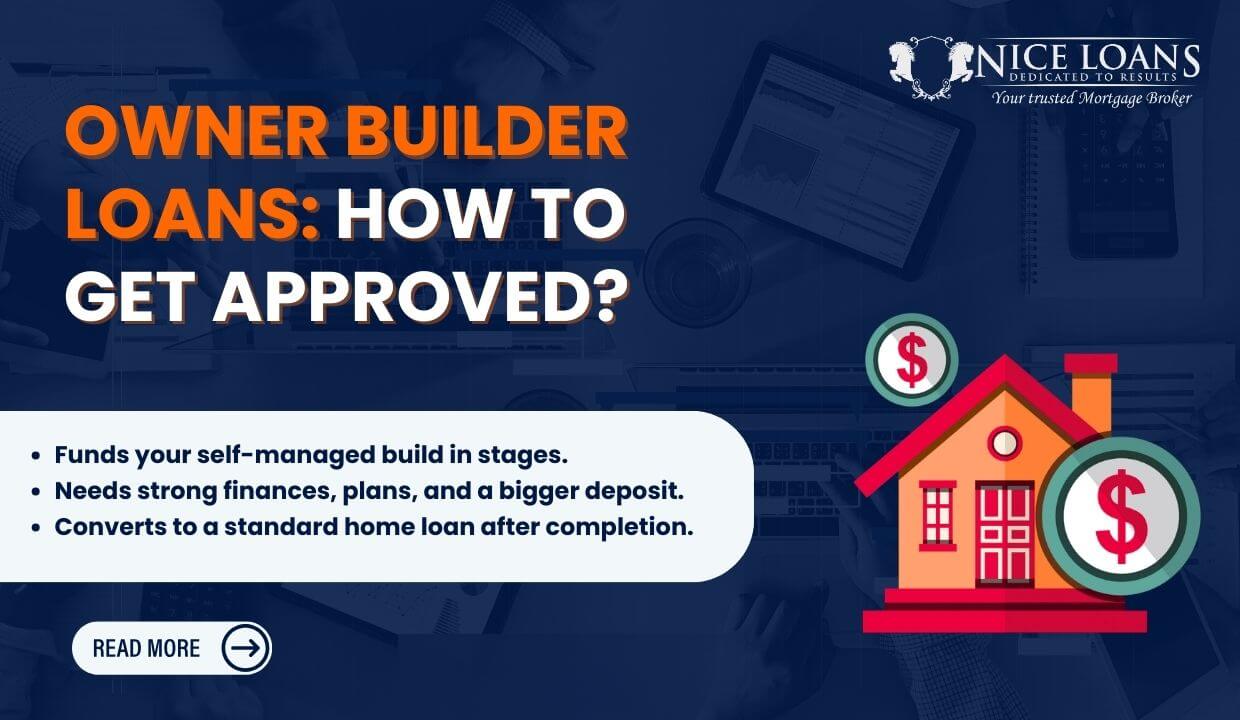
The owner builder loan provides funds progressively throughout the construction process, covering approved building-related expenses such as materials, subcontractor labour, site works, permits and structural stages of the build.
With the responsibilities that come with acting as the project manager, lenders require evidence of relevant experience, strong financial stability and detailed construction plans before approving the loan.
Read: Can I Use My Super to Buy a House?
What Costs are Covered by Owner Builder Loans?
The owner builder construction loan may cover:
- Land purchase and site prep costs
- Foundation and slab work costs
- Structural framing and roofing costs
- Plumbing and electrical costs
- Licensed contractor or labour costs
- Cost of building materials and supplies
- Council fees and building permits
- Progress inspections and valuation fees and charges
Funds are generally paid via staged drawdowns, so you can access money only for completed works. While construction loans are comprehensive, they do not cover architectural design fees, interior design fees, engineering reports, personal labour, furniture, decor, or other related expenses.
Calculate your rental yield to find out the real profit on your investment property!
How Do Owner Builder Finance Loans Work?
Owner builder finance loans are structured differently from standard home loans because here the traditional role of building falls upon the borrower themselves. What this does is increase responsibility with risk, exactly why lenders apply a stricter assessment criteria and tighter controls and inspection throughout the construction process.
Save thousands by cutting on your home loan interest with offset accounts and a redraw facility!
Owner builder loans, if managed properly, can successfully fund a personalised, well-executed construction project, but preparation and budgeting are essential to avoid complications. Below is a detailed breakdown of how owner-builder loans typically work:
Understanding the Responsibility
As an owner-builder, all responsibility naturally falls upon you. You effectively become the project manager and general contractor for your build. Which means you’re naturally responsible for all processes from hiring and managing subcontractors or labourers to scheduling construction stages and everything in between.
There is a massive liability shift. If there are construction defects, safety concerns, delays or accidents, you carry all legal and financial responsibility. This is the very risk that leads to lender hesitation in terms of funding an owner builder home loan or any construction loan for that matter.
Try debt recycling to turn your home loan debt into tax deductible debt!
Planning Before Applying
Every project needs absolute planning. In the case of owner builder loans, lenders are less likely to approve a construction home loan without detailed documentation. You will typically need architectural drawings, building specifications, site plans, and detailed energy compliance documentation. If required, engineering plans are also expected.
A clear budget outline highlighting material costs, subcontractor labour, council fees and permits, site preparation and utility connection should be provided. A contingency allowance of usually 10 to 20 per cent is also expected. A well-prepared cost breakdown shows lenders that you understand the financial scope of the project.
Did you know that you can avoid paying the lenders mortgage insurance? Learn more to buy your dream property with a smaller deposit while paying zero LMI!
Understanding the Loan Terms
Before you begin, you need to understand the factors that govern an owner builder loan. Let’s begin with LVRs. In comparison to standard construction loans, owner builder finance loans usually have lower Loan to Value Ratios. The typical range falls between 60 and 70 per cent of the total project cost or 60 and 70 per cent of the end value. Which means that you are required to contribute a much larger deposit or have significant equity in the land to get approved.
Interest rates are higher than standard home loans, naturally, because of the increased risk profile. Construction loan interest rates are often about 1% higher than traditional mortgages. Rates are typically variable during the building phase and range depending on market conditions, borrower credit and the LVR. Funds are released through stages; when one is complete, a certain sum is released, and likewise, the line keeps running. This progressive drawdown helps ensure security. Ultimately, understanding these terms helps prepare an accurate calculation of how much equity or home deposit you need!
Buy a new home without selling your old one with Bridge loans!
Loan Application
Once planning is complete and you have understood all loan terms, the next stage is a formal loan application. You will need your financial information, project documents and all insurance in place before the construction begins.
While there are lenders that may not require full tax returns or financial statements in certain scenarios, you must still prove serviceability and financial stability. Your income declaration, employment and business details, credit history and existing asset and liability statements prove to lenders that you are indeed capable of repaying the loan.
Move homes without changing your existing mortgage with home loan portability!
To ensure trust, lenders require full construction plans, a detailed cost breakdown, fixed quotes from subcontractors and a thorough timeline of works. Proof of land ownership or a purchase contract is also expected. This is because, as an owner builder, you are taking a construction home loan where all liability is upon you.
Last but not least, before construction begins, you must arrange construction insurance, public liability insurance, and workers’ compensation where applicable. Please note that insurance is mandatory to secure the lender’s contribution.
Discover stamp duty and understand taxation rules early to help reduce home building costs!
Loan Approval
Whether your loan will be approved depends on your financial position, your project background and the risk involved in lending to you. You could have a ton backing you financially, but if your project is weak, nothing can be done. When any approval is granted, a lender is putting absolute trust in you to utilise and repay the provided loan. While risks are involved, it is in their right to want to diminish them as much as possible.
Also Read: Negative Gearing Vs Positive Gearing: Pros and Cons.
Managing Drawdowns
With every stage of construction progressing, you request drawdowns from your lender to pay for completed work. One after another, the funds are released. Before each drawdown, a progress inspection is conducted by a lender-appointed valuation specialist. The inspector confirms stage completion, and you’re required to submit invoices and receipts. Once all confirmations are made, the lender finally releases funds for that stage.
Ask these 20 important questions to your mortgage broker for the ultimate test!
The process helps lenders avoid overfunding on unfinished work and keeps them on budget. Cost overruns are one of the biggest risks of owner-builder projects, and drawdowns help control the issue. If your budget blows over, the lender may not increase the loan amount, and you might need to cover the shortfall yourself, so prepare to spend carefully.
Secure your dream property without an upfront deposit easily with deposit bonds!
Construction Completion Marks Loan Conversion
When the construction is finally finished, lenders also require an inspection. Once done, a certificate of occupancy is issued. With this, the lender officially confirms project completion. At this stage, the construction loan converts into a standard home loan. If in the past, repayments were typically interest-only on drawn funds, once converted, repayments move to principal and interest unless structured otherwise.
The Australian Government Help to Buy scheme allows homeowners to purchase homes with just 2% deposit. Apply Now!

Differences Between Owner Builder Loans and Standard Home Loans
| Owner-Builder Home Loan | Standard Construction Loan |
| No fixed price builder contract | Fixed price licensed builder |
| Lower LVR | Higher LVR |
| High risk | Lower perceived risk |
| Stricter Assessment | Straightforward Assessment |
| Borrower Manages Project | Builder Manages Project |
Are you a single parent looking to buy a home but don’t have sufficient funds? The Family Home Guarantee Scheme is just the option for you!
Eligibility
As we’ve already established, qualifying for an owner-builder loan is generally more demanding than applying for a standard home loan. Likewise, eligibility requirements are stricter to reduce the risk exposure.
- Strong Credit Profile: Lenders review your credit score, repayment history, defaults or bankruptcies and overall debt levels.
- Proper Planning and Budgeting: You need to provide several documents proving project feasibility and budget accuracy. You need to understand the full scope of work and have a financial buffer for unexpected concerns.
- Experience and Qualifications to Back: While not all lenders require formal qualifications, experiences that demonstrate competence can significantly strengthen your application.
- Proof of Serviceability: Lenders require verification of how comfortably you can repay the loan. Your income stability, employment or business performance and existing debts and expenses are evaluated.
- Sufficient Equity or Deposit: To meet the low LVR requirement of 60% and 70%, you need to have a substantial cash deposit or equity in the land if you already own it.
Understand the differences between conditional and unconditional approval to meet conditions and complete valuation in no time!
What are the Documents Required?
- Personal Identification Documents: Driver’s license or Passport.
- Financial Proof: Payslips or tax returns, records of past debt, assets and other liabilities.
- Project Documentation: Detailed budget, cost estimates and project feasibility proof.
- Insurance Documents: Construction insurance and public liability insurance.
- Contract Documents: All contracts for materials, subcontractors or labourers.
- Land Ownership Proof: If the land is already bought, proof of ownership or a contract of sale.
Discover ways to negotiate your home purchase to lock in the best property offers ever.
Application Process
While owner builder loans do involve more documentation than standard home loans, the overall process follows a clear and structured pathway:
Find out how to buy property in Australia through Australian expat home loans as someone living overseas.
- Begin by discussing your project and financing needs with a lender or mortgage broker. At this point, you’ll be reviewing the scope of your build, the upfront costs, the deposit available and your borrowing capacity.
- Next, you’ll forward a formal loan application along with the supporting documents. Everything from your financial information and construction documentation, to insurance details needs to be provided.
- The lender further conducts a detailed review of your application, and if approved, the lender will issue a formal loan offer outlining the loan amount, interest rate, loan-to-value ratio, construction term, drawdown schedule and repayment structure.
- With the offer accepted and the loan documents signed, the loan is formally established. Funds are released through progressive drawdowns, aligned with construction milestones such as slab or foundation, framing, lock-up stage, fixing and completion.
- Once the construction is complete, a final inspection is carried out, and a certificate of occupancy is issued. At this point, the construction loan transitions into a standard home loan.
Benefits of Owner Builder Loans
Opting for an owner builder finance loan can offer significant advantages to borrowers who are organised, financially prepared and confident in managing a construction project. Following are the key benefits explained:
- Potential Savings: One major motivation for choosing a construction loan is the reduction of overall construction costs. When you manage the build yourself, you can avoid paying the builder’s management fees. Since the materials are sourced directly, negotiations can be done transparently, helping you save.
- Total Control Over Your Build: As the project manager, you have full authority over the design of your home. From materials selection, finishes and fixtures to the construction timeline, everything is up to you. This freedom means building a home tailored precisely to your lifestyle and needs.
- Opportunity to Build Equity: If the total build cost of your property is lower than the market value and the final valuation exceeds the combined land and construction cost, your owner-builder project can create immediate equity.
- Leveraging Land Equity: If you already own the land, the equity on your land can be used as a contribution toward the build itself.
- Interest Only Repayment Until Construction is Complete: With construction loans, not only are funds released progressively, but you also pay only the interest on the amount drawn. The concept of progress payment helps manage cash flow during the building phase.
- Personal Satisfaction and Pride: Apart from all the financial support that comes with opting for owner builder loans, the personal fulfilment of overseeing your own project is abundant. With a completed home build, your skills are honed, and there’s a different pride in ownership.
Risks of Owner Builder Loans
As empowering as the control of your own home build can be, owner-builder projects come with substantial financial, legal and practical risks. Understanding the challenges alongside the benefits before you begin can help you decide whether the path is right for you.
- High Risk: Because the construction is performed without engaging a licensed builder and a fixed price building contract, if the build is overbudgeted or delayed, the lender’s security can be hard to recover. Which means, high interest rates, lower maximum LVRs and larger deposit or equity requirements.
- Difficulty Securing Finance: Many lenders are overly cautious about owner-builder applications. Several concerns hinder approval, from incomplete projects, budget blowouts, to poor work and delays. As a result, approval can be more difficult and time-consuming compared to a standard construction loan.
- Possibility of Budget Blowout: Construction projects often exceed original budgets, even when they’re managed by professionals. In such circumstances, without the experience of a licensed builder, owner-builders may underestimate the true cost of completion. With the approved loan amount exceeded, the lender might not increase the amount, and you might need to fund the shortfall yourself.
- Legal and Liability Exposure: Acting as your own project manager introduces massive liability. You might have to be legally responsible for workplace mishaps, site safety, structural defects and disputes. You must rely on appropriate insurance to minimise risk.
- Project Delays: Managing subcontractors, coordinating materials and scheduling inspections requires strong organisational skills. With the lack of experience, common delays might cause costs to be held, interests can rise and place further pressure on your budget.

Tips for a Successful Owner Build
Taking over an owner builder project requires much more than just enthusiasm; it demands discipline and organisation. So, how can you turn a stressful build into a smooth one? Below are practical tips to make the best out of your build freedom:
- Preparation is everything. Before you begin, make sure you have finalised all architectural plans, confirmed engineering requirements, secured council approvals, learned settlement conditions, obtained all quotes and built a realistic timeline.
- Even though you are managing the project, a trustworthy team determines the quality of the final result. Remember to choose wisely and establish clear expectations.
- Financial planning is vital. Owner Builder projects often fail due to poor cash flow management. To stay financially secure, track every expense, keep all invoices and receipts organised, and avoid unnecessary upgrades while meticulously maintaining your contingency fund.
- Follow all rules and regulations. You are legally responsible for ensuring your project complies with all building codes and permit requirements.
- Clear communication prevents misunderstandings. Confirm all instructions in writing and set clear finish and start dates. Consider holding regular meetings to stay updated.
- As a project manager, you need to monitor all progress.
- Ensure you have appropriate insurance in place. In case of damages and accidents, this will protect you.
- Remain calm, adaptable and solution-focused at all times. Do not make hasty, panic-driver decisions.
Where Do You Begin?
Starting an owner builder can feel overwhelming, especially when it comes to managing the finances for it all. Success begins long before construction, it starts with planning, financial clarity and the right professional guidance.
Before application, ask yourself, do you have the time to manage a construction project? Do you understand budgeting and scheduling? Are you eligible for approval at all? You need to review your borrowing capacity, your savings, existing debts and credit profile all at once. This helps you determine whether an owner builder loan is viable for your circumstances.
You might be interested in: How Much House Can I Afford?
If you’d like personalised guidance on structuring your owner builder finance or need help applying for your construction loan, speak with us at Nice Builds, your trusted mortgage broker based in Brisbane, to explore your options and take the first step toward bringing your dream project to life, right now!
FAQs
How long does it take to get approved for a construction loan?
Construction loan approvals typically take 30 to 60 days. This is longer than a standard home loan because of the assessment procedures involved.
Is it harder to qualify for an Owner Builder loan?
Yes, it is generally more difficult to qualify for an owner-builder construction loan. Owner builder loans work under stricter lending policies and increased financial risk with lower Loan to Value Ratios.
How does a construction loan work when you own the land?
If you already own land, the equity in the property can be used as a deposit for your loan process to progress. While decisions depend on loan structure and construction period, in many cases, owning the land immediately strengthens your application and may eliminate the need for a separate cash deposit.
Are renovation loans available?
Renovation loans are widely available in Australia and can be structured in several ways. You can get a whole loan through equity releases, personal loans, construction loans or owner builder loans. The right option depends on your circumstances and goals.
What are low-doc construction loans?
Low doc construction loans are designed for self-employed borrowers and those without traditional sources of income. You can borrow up to 80% of the land value, including the construction costs; the details are subject to lender criteria.