A reverse mortgage is one of several ways one can borrow money; here, in particular, a homeowner can use the equity in their property as security and borrow a suitable amount. What is equity, you may ask? Equity simply refers to the portion of an asset you truly own. In the context of property, home equity is calculated as the current market value of your home minus any outstanding mortgage or loans secured against it.
For those aged 60 and above, a reverse mortgage is one of several borrowing options available to homeowners, specifically designed to help older Australians access the value tied up in their property without needing to sell it. As a retiree with a significant portion of wealth tied up in their home, equity release is an appealing option, especially when cash flow is limited.
Home Equity release is a more general term, encompassing reverse mortgages and other similar products that enable homeowners to access the value of their property without having to sell it. These products can be complex and not suitable for everyone. Alternatives, such as government schemes like the Home Equity Access Scheme, downsizing, utilising superannuation, or adjusting expenses, may be worth exploring.
Don’t have enough saved for your Home Deposit? A No Deposit Home Loan is just the scheme for you!
What is a Reverse Mortgage?
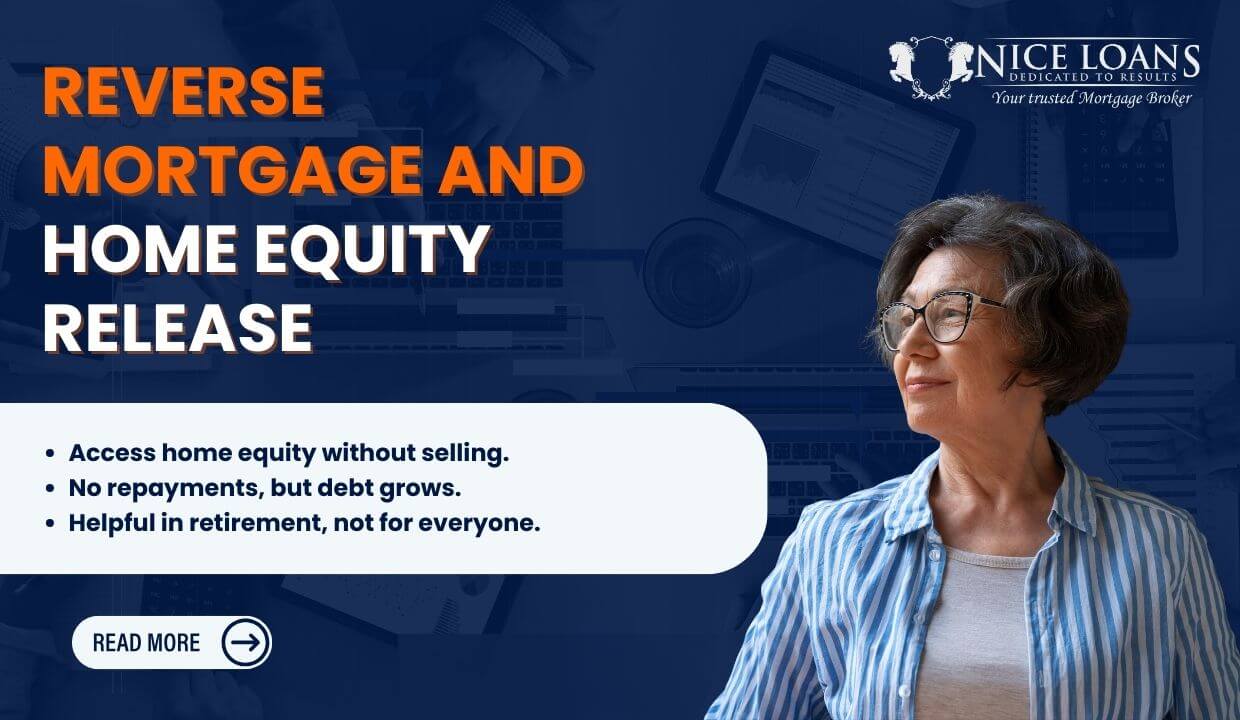
A reverse mortgage is a financial product that allows older homeowners to borrow money using the equity in their home as collateral, without the need to make regular loan repayments as long as they continue to live in the same property. The exact amount you can borrow is influenced by several factors, including your age, the value and location of your property, and the lender’s risk assessment criteria.
At age 60, the amount you can borrow is often limited to around 15-20% of your home’s value, with higher percentages available as you grow older. Given the risks involved, not all lenders offer reverse mortgages. With compounding interests and potential impacts on estate value, complexities can be numerous. It is strongly recommended that anyone considering a reverse mortgage seek independent legal advice before proceeding.
Buying your first home can be nerve-wracking, which is why Australia has a series of First Home Buyer Grants and Schemes designed to help exactly you!
How Does a Reverse Mortgage Work in Australia?
The mechanics of reverse mortgages everywhere are about the same. In Australia, a reverse mortgage allows you to borrow against the equity in your home without the obligation to make monthly principal or interest repayments. Instead, the interest and associated fees are added to the loan balance over time, with the total amount owed gradually increasing over time. The loan is typically repaid when the last borrower dies, sells the home or permanently moves out of the property, likely to an aged care or nursing home.
While you are living in the home, you are still responsible for ongoing costs, including property rates, insurance, and necessary maintenance. Failing to meet these obligations can encourage a breach of the loan agreement and lead to serious consequences, including the sale of property. Australian reverse mortgages are regulated and include a No Negative Equity Guarantee (NNEG) that protects clients from the repercussions of a low in property value. It ensures that you or your estate will never owe more than the market value of the home when it is sold, provided the loan conditions are met!
Read: How Much House Can I Afford?
What is a No Negative Equity Guarantee?
A No Negative Equity Guarantee (NNEG) or negative equity protection is a key feature included in Australian reverse mortgages taken out from September 18 2012, onwards. This guarantee ensures that when a reverse mortgage ends and the home is sold, the amount required to repay the loan will never exceed the final sale value of the property. Even if interest has compounded significantly over time or the property’s market value has fallen, neither the borrower nor their estate will be required to pay more than what the home is sold for.
If the loan balance ends up higher than the home’s value at the time of sale, the lender must bear the loss. Importantly, the lender cannot make any claims against other assets owned by the borrower or their partners. The No Negative Equity Guarantee provides peace of mind for both homeowners and their families, ensuring that a reverse mortgage will not leave the borrowers or respective heirs with additional debt beyond the value of their property.
Your dreams of home ownership are definitely possible with the Rent to Buy Scheme, rent now with the option to buy later!
What Does a Reverse Mortgage Cost?
A reverse mortgage cost depends on several factors, including how much you borrow, how you choose to access the funds, the interest rate and how long the loan remains in place. Reverse mortgages often have higher interest rates than standard home loans due to the increased risk to lenders. In addition to interest, there may be establishment fees, valuation fees, ongoing servicing fees and legal costs.
Over time, your debt will grow, and your equity will decrease. Because interest compounds over time, the total debt can grow significantly, especially if the loan runs for many years. This means that while a reverse mortgage can provide immediate financial relief, it can substantially reduce the equity remaining in your home and the value of any inheritance you plan to leave behind.
Also Read: Understanding Debt to Income Ratio in Australia.

What are the Benefits of a Reverse Mortgage?
One of the primary benefits of a reverse mortgage is that it allows seniors to access tax-free cash without having to sell their home. Because the funds received are considered loan proceeds rather than income, they are generally not subject to income tax. However, they may affect eligibility for certain government benefits depending on individual circumstances.
Find out the risk involved in getting your home loan approved by understanding the concept of loan to value ratio!
It isn’t bizarre for retirees to be rich in assets accumulated over time but lack income or income sources. To these individuals, a reverse mortgage is a great way to eliminate mortgage repayments, free up cash flow, and achieve greater financial flexibility. Regardless of the uncertainties, a reverse mortgage for older Australians means a stable future and the ability to maintain their standard of living without relying solely on superannuation or the mandated age pension.
Refinance to get better loan rates and features! Read our article on when to refinance a home loan to find out exactly why and how!
Help With Expenses at Retirement
As people age, it is common for income to decrease due to reduced working capacity or retirement. However, the economic condition can be far from lenient; expenses such as health care, home maintenance and daily living costs can increase rapidly. So, given the circumstances, how exactly do you go about fulfilling these needs as an older individual?
A reverse mortgage can help bridge the gap between needs and the ability to satisfy them by supplementing retirement income without requiring access to savings or superannuation. Since there are no repayments required while living in the home, retirees can manage their finances more comfortably and use the funds for medical bills, home modifications or general living expenses.
Get help with construction expenses for your self-build with owner builder home loans!
You Don’t Need to Move
Among many, one of the most appealing aspects of a reverse mortgage is the ability to remain in your home while accessing its value. For many seniors, as it should be, staying in familiar surroundings is emotionally important and contributes to much more than just their psychological well-being. Moving or downsizing can be an option when expenses weigh heavy, but it can be both costly and stressful. A reverse mortgage allows homeowners to age in place, maintaining independence while unlocking funds for personal needs. In some cases, this may be more cost-effective than selling and purchasing a smaller property or renting. Utilising what has long been collected can be a smart way to access benefits shortly.
With only 2% deposit and no lender’s mortgage insurance (LMI), single parents can purchase property without stress. The Family Home Guarantee Scheme is an initiative designed to support legal guardians of at least one dependent child. Learn more now!
Tax-Free Earning
Unlike with other income sources, where taxes are mandatory, funds received from a reverse mortgage are generally tax-free because they are classified as borrowed money rather than income. The money you get from a reverse mortgage isn’t taxable because these are considered loan proceeds and not earnings per se. This can make the product attractive compared to others that may be subject to taxation. However, it is important to note that while the funds themselves may not be taxable, they could affect eligibility for certain government benefits. Consulting a financial adviser can help clarify how a reverse mortgage might impact your overall financial position.
Learn everything you need to know about home loan deposits through our piece on how much you need for a house deposit!
Protection Incase Home Value Changes
If it just so happens that your home’s value plummets to a loss, the repayment to cover the flop isn’t your responsibility. Australian reverse mortgages include a no negative equity guarantee, which means that if the value of your home falls or the loan balance grows beyond the property’s value, neither you nor your associates will be required to repay more than the sale price of the home.
This borrower protection feature eliminates a major risk associated with reverse mortgages, cancelling out the chances of borrowers and their heirs being left with additional debt. In case the lender pushes to make claims against other assets outside the property, it is considered null and unlawful, providing an important safeguard for families.
Don’t have cash for an upfront deposit? A deposit bond keeps your funds in assets while helping you purchase the dream home!
What are the Drawbacks?
While there are benefits, overlooking potential threats can be harmful. Reverse Mortgages carry significant risks and are not suitable for everyone. Because interest compounds over time, the loan balance can grow rapidly, reducing the equity remaining in the home. Being left with nothing toward the end can be a frightening revelation. This can limit future financial options and significantly reduce the inheritance left to beneficiaries. Reverse mortgages are also long-term commitments, and exiting early can be expensive.
Did you know that you could pre-approve your home loan with zero costs?
Fees and Ongoing Costs
Reverse mortgages don’t service for free. They involve various fees, including establishment fees, valuation fees, legal costs and ongoing servicing charges. While several of these costs can be directly added to the loan balance, doing so increases the total amount owed over time. Additionally, borrowers must continue to pay property-related expenses such as council rates, insurance and maintenance; failure to meet these obligations can result in default and potential forefeiture. Understanding your financial requirements and capacity before committing is advised.
Are you self-employed, looking to buy yourself a home? A low doc home loan is just what you need!
Impact on Heirs
When the borrower is no longer in the home, either dead or just not living there anymore, the reverse mortgage either has to be repaid, or the property has to be provided to the lender. This scenario often calls for the sale of the home, which can be emotionally challenging for the family members. For the borrowers, it is an easy outcome, but for non-borrowers, this can cause complications. If little to no repayments were made during the loan term, the amount owing may be substantial, so repayment is usually not viable. While there are protections in place for surviving spouses, they only apply if you were listed as the borrower from the beginning.
Check Out: Can I Use My Super to Buy a House?
Impact on Government Benefits
Receiving reverse mortgage funds can affect your eligibility for certain government-based benefits that are provided upon pre-test, meaning they are assessed based on your income and assets. Even with the money received from a reverse mortgage being considered a loan rather than taxable income, the amount of time you hold or use those funds can influence how government agencies assess your financial situation. If you happen to keep the borrowed funds stored in the bank for a specific period, they could be counted as an asset, further eliminating eligibility for certain assistance programs.
You might be interested in: Refinancing a Home Loan with Bad Credit.
Should you apply for a Reverse Mortgage?
Whether you should or shouldn’t apply for a reverse mortgage largely depends on your individual financial circumstances and what you wish your financial future looked like. Before making the extreme decision, it is essential to fully understand how reverse mortgages work, including their benefits, limitations and long-term implications. What seems harmless today can bite back with heftier repercussions later on.
As an older homeowner, there are several factors you must carefully consider. Your age, finances and transactional experiences should serve as advantages, helping you make informed choices rather than decisions that could lead to a financial strain. Also, remember to consult a mortgage broker where possible!
While a reverse mortgage can provide additional income or financial flexibility, it is not a solution that eliminates all financial responsibility. Homeowners are still expected to maintain the property, pay property taxes, keep up with insurance and manage their finances wisely. A reverse mortgage is not a way to escape financial duties, but an economic tool that helps manage those finances.

Home Equity Release
A home equity release is a broad term that refers to a range of financial products that allow homeowners to borrow cash tied up in a property without selling their home. Most commonly marketed towards older homeowners who have a ton in terms of assets but lack the cash to fund or supplement their income later in life, through equity release, they can borrow against the value of their home while continuing to live in it. Depending on the type of product chosen, borrowers can either make regular payments or not. The amount you can access depends on your age, the value of your property and other lender policies.
Wish to pay off your mortgage faster? Our article offers proven tips to pay off your home loan in only 10 years!
It’s important to remember, however, that equity release products, often referred to as later-life mortgages, are complex and come with long-term financial implications. It is common for the borrowed amount, along with any accrued interest and fees pending, to be repaid from the sale of your home when you pass away or permanently move into long-term care.
While equity release can definitely provide financial flexibility and improve the quality of life in retirement, it can also reduce the equity left in your home and affect your estate and government benefit entitlements. The impacts can seep through a generation if not thought through wisely enough. It is important to carefully consider the advantages, disadvantages and available alternatives and to seek independent legal and financial advice before proceeding.
Looking to buy a property in Queensland? Learn the Stamp Duty regulations in QLD for this 2026 season!
Other Home Equity Release Options
Besides reverse mortgages, there are several other ways homeowners can access the equity built up in their property. While all equity release options pretty much share the same general purpose of unlocking the value of your home, they operate quite differently. For instance, we can name three: home equity loans, home reversion schemes, and the Home Equity Access Scheme. Understanding how each option works is essential before deciding which solution best suits your financial needs and goals.
Discover the best home loan options for self-employed individuals!
Equity Release Loan
An equity release loan allows homeowners to borrow additional funds using their home as security, either by increasing their existing mortgage or by taking out a separate loan. The amount you can borrow depends on the lender’s policies, your income and repayment capacity and the value of the home. Typically, the loan amount is calculated as a percentage of your property’s appraised value, minus any outstanding home loan balance. Unlike reverse mortgages, equity release loans require regular repayments of principal and interest and are commonly used by borrowers who are still earning an income.
Also Check Out: What are Bridge Loans and How Do They Work?
Lenders generally demand a clear and acceptable purpose for releasing equity, as not all uses are approved. Commonly accepted reasons include purchasing another property, undertaking minor cosmetic improvements, major structural renovations to your home or consolidating existing debts into a single, more manageable loan. In some cases, leaders may also allow equity to be released for investment purposes, such as investing in shares, investing in properties or funding a business. However, these uses are assessed more strictly due to higher risk. Using released equity for discretionary spending, such as purchasing a luxury vehicle or funding a holiday, may be allowed by some lenders, but it often comes with tighter lending criteria.
The equity release loan, as with all equity release products, increases your overall debt, and if not studied carefully, could leave you at a greater financial risk. It is essential to assess your repayment capacity and economic stability before proceeding.
Discover the Australian Help to Buy Scheme and purchase a property with just 2% deposit, a smaller loan and no LMI!
Home Reversion Scheme
Home Reversion Schemes are relatively limited in Australia. This option allows you to sell a portion of the property’s future value while you continue to live in your home. In return, you get a lump sum payment and retain ownership of the remaining share of your property.
The provider pays a discounted amount for the portion of the home you sell, with the discount largely based on your age and life expectancy. Generally, the older you are, the higher the percentage you receive for the share sold. While terms vary between providers, some schemes offer a rebate feature. If you sell your home or pass away earlier than expected, you or your estate may receive a partial refund. In some cases, you may also have the option to buy back the sold share later on.
Because the home reversion scheme is not a loan, much like other equity release products, there is no interest charged. Instead, the costs typically include transaction fees, valuation fees and other associated property expenses. The main financial trade-off is the difference between the discounted price you receive today and the future market value of the share you sell.
Understand exactly what’s different about conditional approval and unconditional approval to pass your home loan applications fast!
Home Equity Access Scheme
The Home Equity Access Scheme (HEAS), formerly known as the Pension Loans Scheme, is administered by Services Australia and the Department of Veterans Affairs. It allows eligible older Australians to receive a voluntary, non-taxable loan on a fortnightly basis from the government. The amount can be used to supplement your retirement income and improve financial security during later life.
You or your partner can secure the loan against personally owned real estate. You have the flexibility to choose how much of your property you wish to offer as security, as well as the amount you would like to receive fortnightly. However, your combined pension and loan payments cannot exceed 1.5 times the maximum fortnightly pension rate.
Although the scheme offers an attractive offer of flexibility, there is also a limit on the total amount you can borrow over time. This limit is determined by factors such as your age, your partner’s age if applicable and the value of the property used as security for the loan. It is important to remember that the loan, along with all associated costs, needs to be repaid to the government.
You don’t need to make regular repayments as long as conditions are met. Importantly, all loans under the scheme include a Negative Equity Guarantee, so you’ll never have to repay more than the value of your home. This provides added peace of mind when considering the scheme as part of your retirement planning.
Are you a property investor? Immediately calculate your rental yield to compare your property value with your rental income!
Should You Apply for a Home Equity Release?
Once again, with home equity releases, borrowers can gain valuable financial support, particularly as homeowners seeking funding later in life when regular income may be limited. These options can cover everyday living expenses, medical costs or home improvements, offering greater financial flexibility during retirement.
However, they also come with potential risks, including increased debt and reduced inheritance for beneficiaries. In some cases, accessing home equity may also affect eligibility for certain government benefits. While home equity release can offer flexibility, it is not a one-size-fits-all solution. Carefully reviewing your financial position, future needs and repayment ability is essential. Take time to explore each option, compare benefits and drawbacks and seek professional guidance where possible.
Should you negatively gear or positively gear your investment properties for the benefits you want to achieve? Find out now!

Need Help Choosing the Right Mortgage?
If you need help with your mortgage or equity release solutions, Nice Loans, your trusted mortgage broker in Brisbane, can help you find the way. Contact us today to book a consultation with our experienced range of professionals. With us, the mortgage solution best suited for your needs is only a call away!
FAQs
Which Banks Offer Reverse Mortgages in Australia?
Reverse mortgage providers in Australia are primarily specialist non-bank lenders and a small number of mutual banks. Some of the more recognised providers include Heartland Bank, Police & Nurses Credit Union, G&C Mutual Bank, Gateway Bank, and ASAG, among others.
Which Equity Release Option Gets Money Quickly?
All mortgage products involve a settlement period, and timelines vary depending on the lender and individual circumstances. While traditional lenders follow standard approval processes, some online and specialist lenders aim to accelerate approvals, with a few offering access to funds within days or weeks.
Try debt recycling to pay off your mortgage while simultaneously building wealth through investments!
Which is the Cheapest Option?
All home equity release products involve costs. The Home Equity Access Scheme, for instance, currently charges around 3.95% interest. For the Equity Release Loan, closing and associated costs typically range between 1 to 5 per cent of the total loan amount, depending on the lender and loan structure. While for the Home Reversion Scheme, the cost varies depending on property growth. Reverse Mortgages are usually the most expensive in long-term costs compared to other equity release products, given that they allow access to larger sums upfront.