
Property investment has seen a significant rise in popularity over the past several years. Today, many people no longer aim to own a home solely as a place to live; instead, the idea of generating additional income through property investment has become increasingly appealing. While plunging into further real estate may seem out of reach for those on lower income scales, it remains one of the most widely recommended ways to use capital to build long-term wealth.
In the context of property investment, gearing refers to the use of borrowed funds, usually through a loan or mortgage, to purchase an investment property. Gearing plays a major role in shaping an investor’s strategy, risk levels and potential returns. It allows investors to buy properties without funding the entire purchase cost from their own resources.
If you take out a loan to purchase a rental property, your investment is considered geared. All expenses associated with owning the property, such as loan repayments, interest, maintenance costs, insurance, property management fees and taxes, are compared to the rental income earned over the financial year.
Buy your first home without a deposit with no deposit home loans!
Your property investment will generally fall into two categories: positive gearing and negative gearing. Although these terms may sound incoherent at first, the concept is actually quite simple. Gearing is all about whether the income you earn from the property is higher or lower than the total cost of owning it. This distinction is essential and exactly what separates positive gearing from negative.
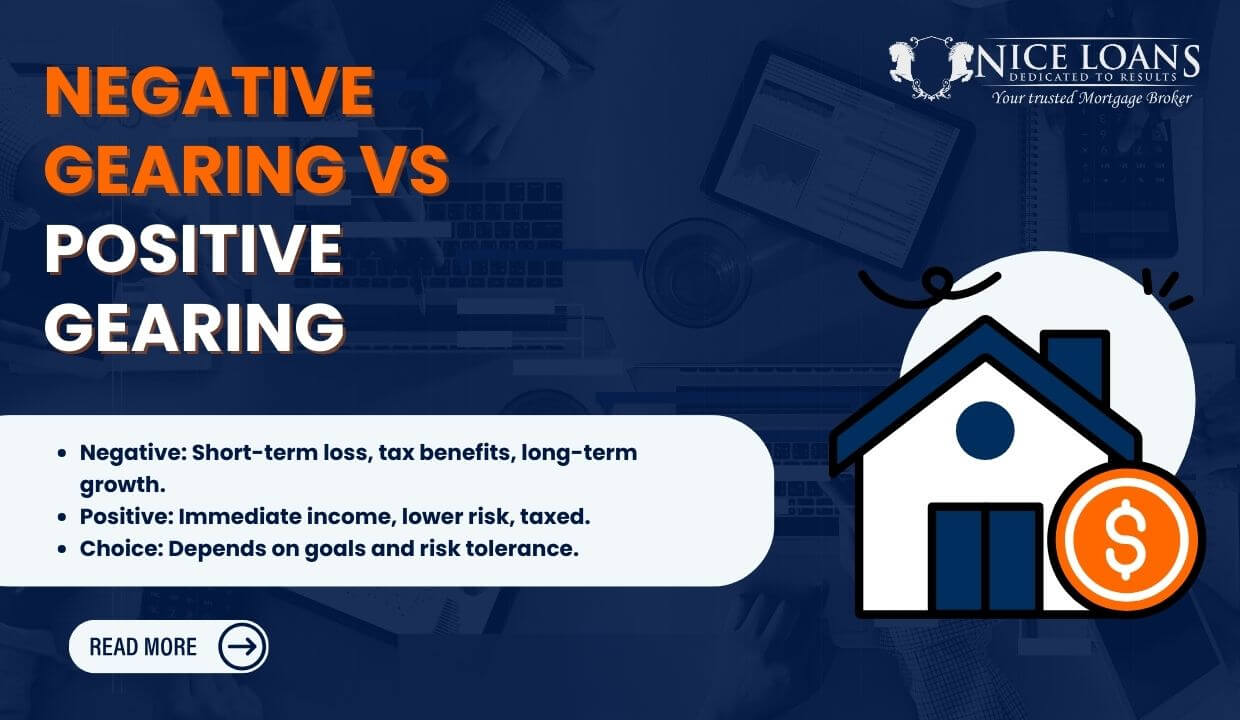
A property is negatively geared when the total expenses exceed the rental income, which means that in case of a shortfall, the investor must cover it out of their own pocket. Some investors accept this in the short term, hoping to benefit from the long-term capital growth and potential tax advantages. However, a property is positively geared when the rental income is greater than all ownership costs. In this case, the property generates an income surplus for the investor.
While gearing may seem complex due to the financial and tax considerations involved, the underlying idea is straightforward. Understanding whether a property is positively or negatively geared helps investors make informed financial decisions.
Discover QLD’s First Home Buyer Grants and Schemes to get a massive chunk off the expenses on your new home!
Negative Gearing Explained
Negative gearing occurs when an investment property costs more to own than the income it generates. The burden of ownership outweighs the bliss of earning. The expenses associated with the property, such as loan repayments, interest, maintenance and other outgoing costs, are much larger than the rental income received.
At first glance, negative gearing may seem like a failed investment, a concept doomed at initiation. However, with the right property choice and appropriate financial and tax advice, negative gearing can be a strategic and tax-efficient investment approach. For many investors, the short-term losses are offset by potential tax benefits and long-term capital growth.
Especially for first-time property investors, negative gearing can be a viable option when entering the property market. With additional financial support in the early stages, negatively geared properties can contribute to building a diversified investment portfolio over time. When combined with a long-term growth outlook, you can create massive wealth and achieve your financial goals sooner.
Compare the pros and cons of using a mortgage broker and learn how brokers simplify home loans and offer expert advice.
Key Aspects of Negative Gearing in Australia?
For Australians in particular, or in this context, Australian investors, negative gearing plays a key role as a long-term wealth-building strategy. There are two primary reasons why investors would choose to negatively gear a property. First, investment losses, including eligible expenses and depreciation, can be claimed as tax deductions, reducing taxable income and lowering the overall tax bill. Second, investors often expect the property to increase in value over time, with capital gains eventually outweighing the short-term losses incurred. Key characteristics of negative gearing include:
- Tax benefit: Negative gearing allows you to utilise your tax benefit. It reduces the taxable income, which reduces the amount of tax payable.
- Long-Term Strategy: It’s often used with the expectation that the property’s value will increase significantly over time, cancelling out the annual cash flow losses.
- Other Expenses: Costs including loan interest, council rates, body corporate fees and maintenance, are tax deductible. Check the ATO rental property guide for more information.
- Depreciation: Investors may claim depreciation on the building and certain fixtures, which can increase deductible losses and enhance tax benefits without affecting cash flow.
- Cash Flow Required: Investors must have sufficient income to cover ongoing costs, particularly during periods when the property is vacant and rental income is unavailable.
Read: How Much House Can I Afford?
How does negative gearing work?
It has already been established that Negative Gearing occurs when the costs of owning an investment property exceed the income it generates. While it might initially feel like a loss, negative gearing is not necessarily a bad outcome. When used strategically, it can contribute to massive financial gains through tax benefits and capital growth. But how can that be so? How does an obvious loss lead to profit? The answer lies in understanding cash flow, taxation, and long-term investment growth.
It’s quite simple to determine whether a property is negatively geared. An investor first calculates the total rental income received from tenants over a financial year. Next, all ownership expenses are added together. These expenses may include mortgage interest, property management fees, maintenance costs, insurance, council rates and other related costs. Comparing total income with total expenses reveals whether the property is running at a profit or a loss.
Accordingly, if the expenses exceed the rental income, the property generates a net loss. This is where negative gearing applies. For instance, let’s assume a property earns $30,000 in rental income over a year but incurs $35,000 in expenses, the investor records a net loss of $5000. In Australia, this loss can generally be offset against the investor’s other taxable income, such as wages or salary. If the investor is on a marginal tax rate of 30%, this could result in a tax saving of $1500.
Find out when to refinance your home loan for better interest rates and loan features!
While negative gearing offers financial benefits, it’s important to keep in mind that tax savings only play a role in the bigger picture of a viable investment property. So, while negative gearing could in some circumstances help you save on tax, this shouldn’t be the only reason you’re investing in a particular property or the sole driver of your strategy. For instance, you may not be looking for regular income from the property but be more focused on finding a property with high capital growth because it is as viable as you claim it is not to be. The value of the property is likely to increase above average over time. While this definitely doesn’t eliminate the loss, it reduces the overall impact and improves cash flow.
Focus on strengthening your finances to land the best loan terms even while self-employed!
However, one needs to understand that tax savings alone don’t make an investment successful. Negative gearing is a part of a broader investment strategy. Negative gearing is a useful tool, but it should not be the sole reason for investing in a property. A strong investment decision is based on several factors such as location, growth potential, affordability and financial goals, not just tax benefits. Many investors accept short-term losses because they are focused on what it could provide them long-term. They believe that if the property increases in value over time and is sold for a profit, the capital gain may outweigh the losses incurred along the way.
Are you looking to rent and simultaneously buy the same property? The Australian Rent to Buy scheme is made just for you! Rent now with the option to buy later.

Pros of Negative Gearing
Negative Gearing is a strategy aimed at building long-term wealth, even though it may involve short-term cash flow losses. While it is seemingly counterintuitive for an investor to opt for a scheme that operates at a loss, negative gearing offers several financial and strategic advantages. By accepting short-term losses, investors may position themselves to achieve greater returns. As a result, negative gearing remains an appealing option for investors who are focused on long-term wealth creation rather than immediate income.
See proven tips to pay off your home loan in 10 years to pay off your mortgage faster than ever!
Reduced Taxable Income
One of the most significant benefits of negative gearing is the reduction in taxable income. When the costs of owning and managing an investment property exceed the rental income generated, the investor records a loss. This net loss can generally be offset against other sources of taxable income, including wages or salary.
By applying rental losses to overall income, the investor’s taxable income is noticeably reduced, which in turn lowers their total tax liability. This may result in a larger tax refund at the end of the financial year or less tax being withheld from regular pay throughout the year. For many investors, this tax advantage helps ease the impact of short-term losses incurred through negative gearing, improving overall cash flow while the property is held for long-term growth.
Find out exactly how much you need for a house deposit and pick the option that fits you!
Bigger capital gains over time
When you first read into the concept of negative gearing, given how illogical it is to invest in a property that produces ongoing losses, it’s easy to misunderstand. However, in many cases, these losses are a deliberate and strategic choice rather than the result of poor investment decisions. Investors who use negative gearing typically focus more on long-term growth compared to short-term income.
When properties are shortlisted for negative gearing, localities with strong potential need to be prioritised. A good eye for prospects takes you a long way. Over time, increases in property value can outweigh the accumulated losses incurred during the ownership period. When eventually sold, the capital gain may far exceed all previous losses, resulting in a massive profit. This long-term appreciation is a key reason why many investors accept short-term losses as part of the broader strategy.
Also Read: Understanding Debt to Income Ratio in Australia.
Leverage and Wealth Creation
What might be obvious but is a great advantage is that negative gearing allows investors to use borrowed funds to purchase property, meaning they can control a high-value asset without needing to pay the full purchase price upfront. This use of leverage enables investors to enter the property market with a smaller initial investment compared to buying a property outright.
When the property value increases as predicted, the investor benefits from capital growth on the entire asset rather than just the amount of their own money invested. This can significantly amplify wealth creation. At the same time, as equity builds and property value continues to grow, investors can use this equity to acquire further investment properties, accelerating the expansion of their property portfolio.
Assess the risk involved in getting your home loan approved by understanding the concept of loan to value ratio!
Diversification
Investing in real estate, particularly through negative gearing, allows investors to diversify their investment portfolio. Property investment is a great way to expose yourself to a variety of asset classes compared to traditional investments. By spreading investments across multiple asset types, investors can reduce overall risk and lessen the impact of poor performance in a single market. Diversification through property can improve financial stability and create a more balanced investment strategy, especially when combined with several other investments.
Get pre-approved for your home loan to budget your house loan without hassle!
Retirement Planning
Given that negative gearing is taken to as a long-term strategy, it can play a valuable role in retirement planning. Although the property may operate at a loss in the early years, over time, rental income can increase while loan balances decrease. This can result in the investment gradually shifting from negatively geared to positively geared, providing a more stable and reliable source of income later in life.
Negatively geared properties can also generate significant capital growth over the long term. If the property is sold closer to retirement, the capital gains achieved may help fund retirement expenses or contribute to greater financial security. By accepting short-term cash flow losses, investors may position themselves for long-term wealth creation, making negative gearing an appealing option for those focused on building a stable and comfortable retirement.
Get someone to guarantee your home loan if you don’t have enough cash to cover your home loan deposit. Our piece on who can be a guarantor on a home loan can help you understand more.
Cons of Negative Gearing
Negative gearing has several inherent disadvantages, ones that should not be overlooked. Entering a negatively geared investment involves a great degree of uncertainty, as future outcomes are influenced by factors such as market conditions, interest rates and property performance. As a result, there is no guarantee that the investment will generate the expected returns.
High Risk
You are heavily exposed to risk. The success of this strategy depends heavily on external factors that are often unpredictable, such as interest rate fluctuations, property market conditions and tenant demand. Increases in interest rates can significantly raise loan repayments, intensifying investment losses and placing additional pressure on personal finances. Negative gearing heavily relies on the assumption that the property will experience substantial capital growth over time, which is not guaranteed. If property values decline, the expected long-term gain will never materialise.
Consider debt recycling to invest while indebted!
Financial Pressure
Negative gearing forces an investment property to operate at a loss, only for it to achieve the expected gains much later. This places immense financial pressure on the investor. Because rental income does not fully cover property expenses, the investor must fund the cash shortfall using their own income, which adds significantly to the already predominant strain. Particularly if personal circumstances change or unexpected expenses rise, investors might need to maintain a substantial financial buffer to ensure they can meet loan repayments and other costs without trouble. Without adequate financial stability, the pressure of covering continued losses may outweigh the potential long-term benefits of negative gearing.
Learn the ins and outs of Lenders Mortgage Insurance (LMI) to borrow with a smaller deposit!
Reduced borrowing power
Negative gearing can reduce an investor’s borrowing power when seeking finance. Lenders may view the negative cash flow that occurs as a result of the loss in income as a liability, which can hinder your ability to borrow money for future investments and other financial needs.
Reduced borrowing capacity can limit financial flexibility, making it harder to respond to unexpected expenses or emergencies. This constraint is an important factor that investors must consider before committing to a negatively geared investment strategy.
Over-dependency on tax policy
Negative gearing relies heavily on existing tax policies and government legislation. Many of its benefits, particularly the ability to offset investment losses against taxable income, are dependent on current tax laws. Any future changes could reduce or remove these tax incentives, potentially impacting the overall viability of the investment strategy.
With dependency so strong on factors outside the investor’s control, the uncertainty and risk are terribly high. Changes in government policy may alter expected returns and require investors to reassess their financial plans.
Check Out: Refinancing a Home Loan with Bad Credit.
Is Negative Gearing Worth it?
Whether negative gearing is the right investment strategy depends largely on the concerned individual and their personal and financial situation. There is no simple approach that suits every investor, and a strategy effective at one stage of life might not be appropriate for another. You must thoroughly weigh the potential advantages and disadvantages before committing to a negatively geared investment.
Negative gearing can be absolutely worthwhile for investors with higher incomes, those who can benefit from tax deductions and are financially stable enough to manage short-term cash flow losses. When combined with strong market conditions and long-term capital growth potential, negative gearing may contribute to wealth creation over time. However, despite the benefits, risks continue to lurk.
The key is to absolutely avoid approaching negative gearing as a guaranteed path to success. Investors must assess their financial capacity, long-term objectives and risk tolerance before deciding whether the strategy aligns with their circumstances. Seeking professional financial advice can also help ensure that negative gearing is operated effectively and responsibly.
Understanding the difference between conditional and unconditional approval can help you meet conditions better, complete the valuation quickly and settle asap.

Positive Gearing Explained
Positive gearing is the exact opposite of negative gearing, and you might find it much simpler to understand. A property is positively geared when the rental income it generates exceeds all its expenses, including loan repayments, maintenance, insurance and management fees. Also known as a class flow positive investing, positive gearing is particularly appealing to investors seeking a steady, passive income stream.
Basically, positive gearing means that the property produces a profit in the income each year, even after all costs are paid. Unlike negative gearing, where investors accept short-term losses for potential long-term gains, positive gearing provides immediate financial returns. The benefit is straightforward and quick; you earn extra income directly, which can support your lifestyle or be reinvested.
The major difference between positive and negative gearing lies in the financial scenarios. With positive gearing, the income is taxable, so the net benefit depends on your marginal tax rate. Additionally, when the property is sold, any capital gains may be subject to tax. Regardless, though, positively geared properties are often favoured by investors who prioritise regular income and financial stability over long-term capital growth.
Buy with just 2% deposit while avoiding LMI as a single parent in Australia with the government’s exclusive Family Home Guarantee Scheme.
How does Positive Gearing work in Australia?
Positive gearing in Australia, much like everywhere else, takes effect when rental income generated from an investment property exceeds its total expenses, including mortgage repayments, maintenance, insurance and management fees. The strategy focuses on selecting properties that are likely to produce strong returns from the beginning.
Investors typically aim to purchase properties in high-yield areas, locations where rental income is high compared to the property’s purchase price. By doing so, rental payments from tenants can cover all property costs and generate a surplus, providing immediate cash flow benefits. This steady positive cash flow helps investors manage loan repayments while reducing reliance on capital growth and allowing for personal or investment use of the surplus income.
Also Check Out: Can I Use My Super to Buy a House?
Managing tax implications is also a key aspect. While the surplus rental income is taxable, investors can often offset some costs through allowable deductions, which can reduce overall tax liability. The combination of steady income and careful tax management makes positive gearing an attractive option for investors seeking immediate financial returns.
You don’t have cash on you, but urgently require a cash deposit for your home loan? Deposit bonds can help secure a property without an upfront deposit!
Pros of Positive Gearing
Positive gearing is an easy-to-understand, almost straightforward concept, much different from the winded Negative Gearing approach. The goal is to make sure your income exceeds the total expenses on a property, creating a surplus of cash flow from the very beginning. This approach offers several key advantages:
Regular Cash Flow
One of the main advantages of positive gearing is the regular and immediate cash flow it generates. From the moment the property is rented, the investor is receiving their share of the property expense, making it so that they don’t need to cover the loan repayments or pay for other costs out of their own pocket, naturally boosting personal savings or enhancing their lifestyle.
Positive gearing is a property investment strategy that aims for a cash flow positive, unlike negatively geared investment properties, where profits rely on long-term capital growth and may take years to materialise. Positively geared properties strive not to make a loss, and the regular and stable cash flow makes it easier for investors to plan their finances, reduce dependency on other sources of income and maintain financial security while continuing to build their investment portfolio.
Building your own home? Owner builder loans are just the support you need, fund your construction throughout the building process!
Reduced risk and stress
With positive gearing, you are not really placing yourself in a high-risk situation where outcomes are uncertain or difficult to manage. Instead, with positive gearing, you’re doing exactly what you’d expect to do when you first buy an investment property. You are entering a more predictable financial situation as the property generates enough income to cover its ongoing expenses and still produces a surplus.
Given that the rental income offsets costs such as mortgage repayments, maintenance and management fees, there’s no need to cover the shortfall, because it simply wouldn’t exist. Overall, positive gearing offers greater financial stability and peace of mind, allowing investors to manage their property with confidence and reduced stress.
You might be interested in: What is a low doc home loan?
Used to interest rate bumps
When it comes to property investment, knowing whether you can or cannot absorb higher repayments without immediate financial stress is essential. In the case of a positive gearing strategy, debt levels are low and organised because you’re consistently making money from your investment. Here, you become less vulnerable to sudden interest rate increases that could otherwise turn a profitable investment into a financial fix. Remember to be diligent and disciplined with your repayments such that interest rate spikes or unexpected financial pressures are less likely to come as a surprise.
Extra income helps you save
When you have a regular income stream alongside your primary source of income, your ability to save can significantly improve. The extra income provides greater financial flexibility, allowing you to put money aside for goals you have long wished to achieve without worrying about the miscellaneous costs of owning a property. Because essential expenses are long covered, the surplus income can be directed toward savings or reinvested into other opportunities.
Improved borrowing capacity
Unlike with negative gearing, where you have a clear lack of earnings, with nothing but the tax return to hope for, positive gearing provides a consistent stream. This ongoing cash flow makes borrowers more attractive to lenders as it demonstrates financial stability and the ability of meet further repayments without trouble.
With positively geared properties, lenders are more willing to approve higher loan amounts, improving the investor’s overall borrowing capacity. With increased borrowing power, investors can choose to reinvest and further expand their portfolio.
Borrow money by releasing your home equity or using a reverse mortgage. Simply provide a portion of an asset you truly own and get the required amount in return!
Cons of Positive Gearing
When it comes to positive gearing, while the possibilities of loss are low, and you will be mostly at ease, for those looking for substantial growth in real estate, it can be understandably underwhelming. The issues with positive gearing are actively prevalent, as with any other type of scheme. Therefore, it is essential to fully understand both the advantages and disadvantages before making an informed decision.
Tax Liability
Here, income from your investment cannot help you escape the tax you pay or claim a tax deduction. As the profit is added to the investor’s overall income, such as salary or wages, the additional earnings from your investment are also then taxed at the investor’s marginal income tax rate.
Unlike negative gearing, where investment losses can be used to offset other taxable income and reduce the amount of tax you pay, positive gearing results in an immediate tax obligation. This can reduce the net financial benefit received.
Similar: Stamp Duty in QLD 2026.
Slower Capital Growth
Positively geared properties are often located in areas where property prices are lower, and the investment is less. Here, the market demand might not be as strong. Locations, including regional, rural or less densely populated suburbs, are targeted. While purchase prices in these areas may be more affordable, rental income is also generally lower, which can limit the potential of the expected capital growth.
Properties in such regions may experience slower increases in value over time compared to those in major metropolitan areas. Even with a steady cash flow, investors may need to accept more modest capital return, making the strategy unsuitable for those looking for long-term value.
Fewer Tax Benefits and Deductions
Unlike with negative gearing, you’re not offsetting losses, so your eligible deductions are generally not as high. Because the property is generating profit, there are fewer opportunities to use property-related expenses to reduce overall taxable income.
Tax benefits and deductions are more substantial with negative gearing, where ongoing losses can be used to lower taxable income. Because you’re already producing a surplus with positively geared properties, the tax system treats that profit as additional income; thus, you are not able to claim a tax benefit of any sort.
Investors should factor this into their budget, perhaps reach out to an accountant or financial planner to discover which gearing strategy best aligns with their goals and needs.
Are you in a hurry to buy a new property but don’t have the funds to secure it? Try bridging finance to secure your new home without selling the old one.
Vulnerable to Market Shifts
Regardless of the immediate cash flow, positive gearing remains vulnerable to changes in market conditions. Factors such as declining rental prices, increased vacancy rates or unexpected rises in interest rates can reduce or eliminate the cash flow. When such shifts occur, a previously stable investment may quickly become less profitable or even financially burdensome.
Any gearing strategy with a strong dependency on market performance carries inherent risk. The market is constantly changing, and this reliance can cause doubt and uncertainty, making it essential for investors to monitor market conditions closely.
A traditional deposit can be immensely burdensome on low-income families. The Help to Buy Scheme is an initiative introduced by the Australian Government to help such communities, learn more now!
Is Positive Gearing Worth It?
Home loans and property investments naturally carry risk, whether it’s your first property or you’re a seasoned investor. The stakes can feel high and the financial decisions nerve-racking, but positive gearing offers a strategy designed to reduce uncertainty.
Positive gearing is particularly popular among investors seeking stability, especially in a high-interest-rate environment where financial pressures can escalate quickly. When sufficient income is generated to cover property expenses while still producing a surplus, investors can manage ongoing costs while providing a valuable financial buffer. As first-timers, positive gearing can be an attractive option as it reduces risk and financial stress. The immediate income can ease cash flow pressures, making investment easier to maintain even during economic uncertainty. Over time, this steady surplus may also support faster portfolio growth by improving borrowing capacity and enabling other opportunities for investment.
In the end, whether property gearing is worth it depends on an investor’s goals and risk tolerance. For those who prioritise consistent income, financial security and lower risk over rapid capital growth, positive gearing can be worthwhile and sustainable.

Which Investment Strategy Should You Opt for This 2026 Season?
To be honest, there is no single right or wrong investment strategy, as what works for one might not be suitable for another. The investment strategy you opt for this season depends most on the property market and then on your individual financial situation, including your risk tolerance and long-term goals. Property prices and rental demand fluctuate heavily depending on broader economic conditions; thus, market awareness and research are essential.
For investors seeking steady, reliable income and lower financial risk, positive gearing may be the preferred option. This strategy is particularly appealing for those who value cash flow and stability. On the other hand, investors who are focused on long-term capital growth and potential tax advantages may find negative gearing more suitable, despite the higher short-term costs.
Ultimately, the key to maximising returns, whether in the short or long term, is investing in a quality property located in a strong, well-performing area. Doing so increases rental demand and improves the likelihood of strong future buyer interest, helping to secure the success of your investment over time.
If you need guidance in determining the most suitable investment pathway, professional advice can make a significant difference. Nice Loans, a trusted mortgage broker based in Brisbane, offers expert support and industry connections to help you make informed decisions. With the right guidance, you can take confident steps toward achieving your property investment goals.
FAQs
What’s the difference between positive and negative gearing?
The difference is straightforward. Positive gearing represents an investment method where you invest in a property, and the amount you spend on the said property does not exceed the income you make from renting it out, whereas negative gearing occurs when the costs of owning the property exceed rental income, resulting in a loss.
Why is negative gearing bad?
Negative gearing is often criticised because it involves ongoing financial strain and higher risk exposure. Investors need to rely on the probability of future growth to offset current losses, which can be uncertain. It is also linked to massive housing affordability concerns.
What are the tax benefits of negative gearing for Australians?
Negative gearing allows investors to claim property-related expenses against their rental income. This reduces the amount of taxable earnings, lowering overall tax obligations. Consult a registered tax agent or a financial advisor before you make any risky decisions.
Could negative gearing rules change?
Yes, rules can definitely change. Currently, Australia’s tax regulations permit investors to deduct losses from their investment properties against their taxable income, which can provide significant benefits. There have been proposals to limit negative gearing and capital gains tax discounts to one investment property per investor, but these changes are still subject to policy decisions.
What is neutral gearing?
Neutral Gearing is another investment strategy where the income generated from a property is roughly equal to the expense of owning it, resulting in a state where there’s neither profit nor loss. It’s a middle-ground approach between positive and negative gearing.
Where are the best suburbs in Australia for positive gearing?
Positive gearing is common in areas where rental demand is strong, but property prices are relatively affordable. Some top locations include Darwin, Hobart, Perth, and Canberra, among other regional areas. Many suburbs also offer high rental yields, so thorough research is advised.